Introduction
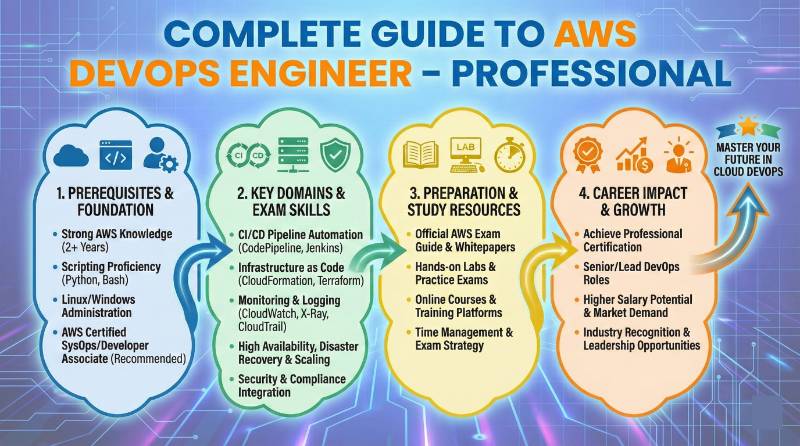
The AWS Certified DevOps Engineer – Professional certification stands as one of the most respected and challenging credentials in the cloud industry, validating your ability to automate, orchestrate, and operate complex workloads on AWS at enterprise scale. This comprehensive guide cuts through the noise to deliver everything working engineers and managers need to know—from exam prerequisites and preparation strategies to real-world skills you’ll gain and career paths you can pursue.
Whether you’re an experienced DevOps practitioner aiming to validate your expertise, an SRE looking to formalize your reliability engineering knowledge, or an engineering manager guiding your team’s professional development, this guide provides practical insights drawn from years of hands-on experience architecting and managing production systems across diverse industries. No fluff, no theory without context—just actionable information to help you understand, prepare for, and leverage this powerful certification throughout your career journey.
What Is the AWS DevOps Engineer – Professional Certification?
The AWS Certified DevOps Engineer – Professional (DOP-C02) is an advanced-level certification that validates your expertise in provisioning, operating, and managing distributed application systems on AWS . Unlike associate-level exams, this one focuses heavily on automation, CI/CD pipelines, infrastructure as code, and operational excellence at scale .
This isn’t just another certification. It proves you can bridge the gap between development and operations, automate complex workflows, and design resilient systems that enterprises rely on every single day .
Who Should Take This Certification?
This certification is designed for:
- DevOps engineers with 2+ years of AWS experience
- Site Reliability Engineers (SREs) managing production workloads
- Cloud architects designing automated solutions
- Senior system administrators transitioning to DevOps
- Platform engineers building internal developer platforms
If you’re already comfortable with AWS and want to validate your automation and operational expertise, this certification is your next logical step.
Skills You’ll Gain
After earning this certification, you’ll have demonstrated proficiency in:
- CI/CD automation – Designing and implementing end-to-end pipelines using AWS CodeCommit, CodeBuild, CodeDeploy, and CodePipeline
- Infrastructure as Code (IaC) – Authoring complex CloudFormation templates, using AWS CDK, and managing infrastructure at scale
- Configuration management – Automating system configurations with AWS Systems Manager and third-party tools
- Monitoring and observability – Implementing comprehensive monitoring with CloudWatch, X-Ray, and centralized logging solutions
- Security automation – Automating security controls, compliance checks, and incident response
- Resilient architecture – Designing highly available, fault-tolerant, and cost-optimized systems
Real-World Projects You Should Be Able to Do After It
This certification isn’t theoretical. After earning it, you should confidently handle:
- Build a complete CI/CD pipeline that deploys a microservices application across multiple AWS accounts with automated testing and approval gates
- Automate the creation of a secure, multi-account AWS environment using AWS Control Tower and custom Service Control Policies
- Implement blue/green and canary deployments for a containerized application on Amazon EKS with zero downtime
- Design an automated incident response system that detects failures and triggers remediation workflows using EventBridge and Lambda
- Create a centralized logging solution aggregating logs from hundreds of EC2 instances across multiple regions
- Implement comprehensive cost optimization automation that rightsizes resources and schedules non-production environments
Preparation Plan
7–14 Days (Rapid Review)
Perfect for experienced professionals who need a quick refresh:
- Days 1–3: Review exam domains and identify weak areas
- Days 4–7: Take practice exams and focus on domain-specific weaknesses
- Days 8–10: Deep dive into AWS Systems Manager, CloudFormation, and CodePipeline
- Days 11–14: Full-length practice exams and review incorrect answers
30 Days (Balanced Approach)
Ideal for working professionals with some hands-on experience:
- Week 1: Complete domain review of SDLC Automation and Configuration Management
- Week 2: Focus on Resilient Cloud Solutions and Monitoring & Logging
- Week 3: Master Incident Response and Security & Compliance domains
- Week 4: Practice exams, hands-on labs, and targeted review
60 Days (Thorough Preparation)
Recommended if you’re new to advanced AWS concepts:
- Weeks 1–2: Build strong foundation in core AWS services
- Weeks 3–4: Deep dive into each exam domain with hands-on projects
- Week 5: Implement real-world projects matching exam scenarios
- Week 6–8: Practice exams, review documentation, and fill knowledge gaps
Common Mistakes to Avoid
- Skipping hands-on practice – Reading documentation isn’t enough. You need to build things.
- Memorizing instead of understanding – Questions are scenario-based. You must apply concepts.
- Ignoring AWS Systems Manager – It appears throughout the exam across multiple domains
- Underestimating multi-account scenarios – Be comfortable with cross-account automation
- Neglecting security integration – Security isn’t separate; it’s embedded in every domain
- Relying only on dumps – They won’t teach you the “why” behind correct answers
Best Next Certification After This
Same Track
- AWS Certified Solutions Architect – Professional – Complements DevOps expertise with advanced architecture skills
Cross-Track
- AWS Certified Security – Specialty – Deepen your security automation capabilities
- AWS Certified Advanced Networking – Specialty – Master complex networking scenarios
Leadership Track
- Certified Kubernetes Administrator (CKA) – Broaden your container orchestration expertise
- HashiCorp Certified: Terraform Associate – Deepen your infrastructure as code capabilities
AWS Certifications Overview Table
| Certification | Track | Level | Who It’s For | Prerequisites | Skills Covered | Recommended Order |
|---|---|---|---|---|---|---|
| AWS Certified Cloud Practitioner | Foundational | Foundational | Beginners, non-technical roles | None | Cloud concepts, billing, core services | 1st |
| AWS Certified AI Practitioner | Foundational | Foundational | Beginners in AI/ML | None | AI concepts, Bedrock basics | 1st or 2nd |
| AWS Certified Solutions Architect – Associate | Architecture | Associate | Solutions architects, cloud engineers | 1 year AWS experience | EC2, S3, VPC, RDS, IAM, architecture | 2nd |
| AWS Certified Developer – Associate | Development | Associate | Developers, DevOps engineers | 1 year development experience | Code services, Lambda, API Gateway | 2nd or 3rd |
| AWS Certified SysOps Administrator – Associate | Operations | Associate | SysAdmins, operations engineers | 1 year operations experience | Deployment, management, operations | 2nd or 3rd |
| AWS Certified Data Engineer – Associate | Data | Associate | Data engineers, analytics professionals | Associate-level knowledge | Data lakes, ETL, pipelines | 3rd |
| AWS Certified Machine Learning Engineer – Associate | AI/ML | Associate | ML engineers | Associate-level knowledge | ML model deployment, SageMaker | 3rd |
| AWS Certified DevOps Engineer – Professional | DevOps | Professional | DevOps engineers, SREs | 2+ years AWS experience | CI/CD, IaC, monitoring, security | 4th |
| AWS Certified Solutions Architect – Professional | Architecture | Professional | Senior architects | Associate-level certification | Enterprise architecture, migration | 4th |
| AWS Certified Security – Specialty | Security | Specialty | Security engineers | 2+ years security experience | IAM, encryption, compliance | 4th |
| AWS Certified Machine Learning – Specialty | AI/ML | Specialty | ML practitioners | Advanced ML knowledge | ML algorithms, model tuning | 5th |
| AWS Certified Advanced Networking – Specialty | Networking | Specialty | Network engineers | Advanced networking experience | Hybrid networking, VPC, DX | 5th |
Choose Your Path: 6 Learning Tracks
DevOps Path
Focus on CI/CD, automation, and operational excellence. Master CodePipeline, CloudFormation, and monitoring tools. Perfect for automation engineers.
DevSecOps Path
Integrate security throughout the DevOps lifecycle. Focus on IAM automation, security testing in pipelines, and automated compliance.
SRE Path
Emphasize reliability, observability, and incident management. Master CloudWatch, X-Ray, and automated remediation.
AIOps/MLOps Path
Combine DevOps with machine learning operations. Focus on automating ML pipelines, model deployment, and monitoring.
DataOps Path
Specialize in data pipeline automation. Master AWS Glue, Lake Formation, and data workflow orchestration.
FinOps Path
Optimize cloud costs through automation. Focus on cost allocation, rightsizing automation, and usage optimization.
Role → Recommended Certifications Mapping
| Role | Primary Certifications | Supporting Certifications |
|---|---|---|
| DevOps Engineer | AWS Certified DevOps Engineer – Professional | AWS Developer – Associate, AWS Security – Specialty |
| Site Reliability Engineer (SRE) | AWS Certified DevOps Engineer – Professional | AWS SysOps – Associate, AWS Advanced Networking – Specialty |
| Platform Engineer | AWS Certified DevOps Engineer – Professional | AWS Solutions Architect – Professional, CKA |
| Cloud Engineer | AWS Solutions Architect – Associate | AWS DevOps Engineer – Professional, AWS Security – Specialty |
| Security Engineer | AWS Security – Specialty | AWS DevOps Engineer – Professional, AWS Solutions Architect – Associate |
| Data Engineer | AWS Data Engineer – Associate | AWS DevOps Engineer – Professional, AWS Machine Learning – Specialty |
| FinOps Practitioner | AWS Certified Cloud Practitioner | AWS Solutions Architect – Associate, AWS DevOps Engineer – Professional |
| Engineering Manager | AWS Solutions Architect – Professional | AWS DevOps Engineer – Professional, AWS Security – Specialty |
Top Training Providers for AWS DevOps Engineer – Professional
DevOpsSchool
DevOpsSchool offers comprehensive instructor-led training for AWS DevOps Engineer – Professional with hands-on labs and real-world projects. Their curriculum covers all exam domains with practical exercises that prepare you for both the certification and actual job responsibilities.
Cotocus
Cotocus provides personalized training programs with flexible scheduling options. Their trainers bring years of industry experience and focus on bridging the gap between theory and practical implementation in enterprise environments.
Scmgalaxy
Scmgalaxy delivers structured learning paths with extensive hands-on practice. Their training materials include recorded sessions, live workshops, and mock exams that simulate the actual certification experience.
BestDevOps
BestDevOps offers specialized bootcamps designed for working professionals. Their accelerated programs help you master key concepts quickly while maintaining work-life balance through weekend and evening batches.
devsecopsschool.com
DevSecOpsSchool focuses on integrating security into DevOps practices. Their training emphasizes automated security controls, compliance as code, and secure pipeline design alongside core DevOps concepts.
sreschool.com
SRESchool specializes in Site Reliability Engineering principles. Their curriculum emphasizes observability, incident response automation, and reliability engineering practices essential for modern SRE roles.
aiopsschool.com
AIOpsSchool combines DevOps with AI operations. Their training covers AI-powered monitoring, automated remediation, and predictive analytics for cloud environments.
dataopsschool.com
DataOpsSchool focuses on data pipeline automation. Their programs cover data integration, workflow orchestration, and automated data quality management.
finopsschool.com
FinOpsSchool specializes in cloud financial management. Their training covers cost optimization strategies, automated rightsizing, and financial governance in multi-account environments.
FAQs: AWS DevOps Engineer – Professional
Difficulty & Time
Q1: How difficult is the AWS DevOps Engineer – Professional exam?
A: It’s one of the most challenging AWS certifications. The difficulty rating is 5/5 due to complex scenario-based questions, lengthy problem statements, and highly similar answer options . You need deep understanding, not just memorization.
Q2: How much time should I dedicate to preparation?
A: Plan for 80–120 hours of focused study. This includes hands-on practice, documentation review, and mock exams. Your actual time depends on your existing AWS experience .
Q3: Is hands-on experience mandatory?
A: Absolutely. This exam tests practical application. You can’t pass by memorizing dumps. Build real projects, break things, and fix them .
Prerequisites & Sequence
Q4: What prerequisites do I need?
A: AWS recommends 2+ years of AWS experience with automation and infrastructure management . You should also have programming/scripting experience and familiarity with CI/CD concepts.
Q5: Should I take Associate certifications first?
A: Yes. Most successful candidates complete Solutions Architect – Associate and Developer – Associate before attempting this professional-level certification .
Q6: Can I take this without any prior AWS certification?
A: Technically yes, but practically no. The exam assumes knowledge covered in associate certifications. You’ll struggle without that foundation.
Value & Career Outcomes
Q7: Is this certification worth it in 2026?
A: Absolutely. DevOps remains a high-demand function with increasing focus on security, automation, and AI integration . Certified professionals report higher credibility and confidence .
Q8: What salary impact can I expect?
A: AWS Professional-level certifications consistently rank among top-paying IT certifications globally . Salary jumps vary by region but are substantial.
Q9: Will this certification help me get a job outside India?
A: Yes. AWS certifications are globally recognized. Many certified professionals leverage this credential for international opportunities .
Exam Details
Q10: What’s the exam format?
A: 75 questions, 180 minutes, multiple choice and multiple response. Passing score is 750/1000. Questions are heavily scenario-based .
Q11: How much does the exam cost?
A: 300 USD. You get 50% off your next AWS certification after passing any exam .
Q12: How long is the certification valid?
A: 3 years. Recertify by passing the latest version of the exam .
FAQs on AWS DevOps Engineer – Professional
Q1: What’s the difference between DevOps Engineer – Professional and Solutions Architect – Professional?
A: DevOps Pro focuses on automation, CI/CD, and operations. Solutions Architect Pro focuses on architecture design, migration, and enterprise-scale planning .
Q2: Which AWS services are most important for this exam?
A: CodePipeline, CodeBuild, CodeDeploy, CloudFormation, Systems Manager, CloudWatch, Lambda, and IAM. Master these inside out .
Q3: How many questions should I expect on CI/CD?
A: About 22% of the exam covers SDLC Automation, making it the largest domain . Expect 15–17 questions on CI/CD topics.
Q4: Is Terraform covered in the exam?
A: Yes, but from an AWS perspective. You need to understand how Terraform integrates with AWS, but CloudFormation receives more focus.
Q5: How do I handle the long scenario questions?
A: Read the last sentence first to understand what they’re asking. Then skim the scenario for relevant details. Practice this technique during mock exams .
Q6: What’s the best way to practice hands-on?
A: Build complete projects. Create multi-account CI/CD pipelines. Automate infrastructure with CloudFormation. Implement monitoring solutions. Real projects beat tutorials every time.
Q7: Can I use exam dumps?
A: Don’t. They’re against AWS certification policies, often outdated, and won’t teach you real skills. You’ll struggle in interviews and on the job.
Q8: How do I maintain my certification?
A: Recertify every 3 years by passing the current version. AWS also offers continuing education options through specific courses .
Conclusion
The AWS Certified DevOps Engineer – Professional certification represents far more than just another credential to add to your resume—it’s a powerful validation of your ability to design, automate, and manage complex cloud systems at enterprise scale. Throughout this guide, we’ve explored everything from exam structure and preparation strategies to real-world skills and career pathways, giving you a complete roadmap for success.
Whether you choose to pursue the DevOps, DevSecOps, SRE, or any other specialized track, remember that this certification serves as both a milestone and a foundation—it confirms your current expertise while opening doors to deeper specialization and leadership opportunities. The cloud landscape continues evolving at breakneck speed, with AI integration, security automation, and platform engineering reshaping how we build and operate systems. By earning this professional-level certification, you’re not just keeping pace with these changes—you’re positioning yourself to lead them.