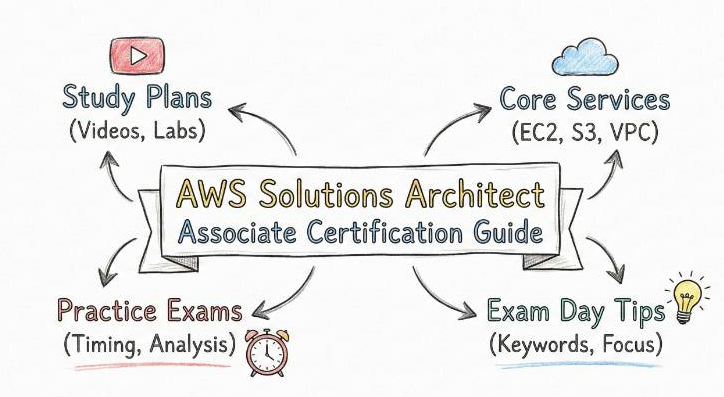
In the current landscape of global technology, the shift to the cloud is no longer a future goal—it is the present reality. For those of us who have navigated the transition from physical data centers to virtualized environments, one thing is clear: the way we design, deploy, and manage systems has fundamentally changed. As a software engineer or a technical manager, staying ahead means mastering the art of cloud architecture.
The AWS Certified Solutions Architect – Associate is widely recognized as the most vital certification for anyone serious about a career in the cloud. It serves as a comprehensive bridge between knowing how to use individual tools and knowing how to build a cohesive, resilient, and cost-effective system. Whether you are based in India’s booming tech hubs or working with a distributed global team, this credential signals that you understand the architectural “big picture.”
AWS Certification Overview
Before we dive into the Solutions Architect Associate, let’s look at how the entire landscape is structured. Navigating these tracks is key to building a long-term career.
AWS Certification Landscape
| Track | Level | Who it’s for | Prerequisites | Skills Covered | Recommended Order |
| Cloud Practitioner | Foundational | Beginners, Sales, Managers | None | Basic Cloud Concepts, Billing | 1st |
| Solutions Architect | Associate | Engineers, Architects | Cloud Essentials | Design, Security, Cost Optimization | 2nd |
| Developer | Associate | Software Developers | Basic AWS knowledge | CICD, Serverless, SDKs, Refactoring | 3rd (Optional) |
| SysOps Admin | Associate | System Admins, Ops | Basic AWS knowledge | Monitoring, Automation, Deployment | 3rd (Optional) |
| Solutions Architect | Professional | Senior Architects | Associate Level | Complex Design, Multi-account, Migration | 4th |
| DevOps Engineer | Professional | DevOps, SREs | Developer/SysOps Assoc | Automation, HA, Security, Governance | 4th |
AWS Certified Solutions Architect – Associate
What it is
The AWS Solutions Architect – Associate (SAA-C03) validates your ability to design and deploy secure and robust applications on AWS. It focuses on the AWS Well-Architected Framework, ensuring you can balance performance with cost and reliability.
Who should take it
- Software Engineers moving into full-stack or system design roles.
- Cloud Engineers and System Administrators managing cloud infrastructure.
- Engineering Managers who need to make informed technical decisions about infrastructure costs and security.
Skills you’ll gain
- Design Secure Architectures: Mastering IAM, VPC security, and data encryption at rest and in transit.
- Resilient Design: Building high-availability systems using Multi-AZ deployments and Auto Scaling.
- High-Performing Architectures: Selecting the right compute (EC2 vs Lambda), storage (S3 vs EFS), and database (RDS vs DynamoDB).
- Cost Optimization: Identifying underutilized resources and choosing cost-effective pricing models like Spot Instances.
Real-world projects you should be able to do
- Multi-Tier Web App: Build a scalable web app with a load balancer, auto-scaling web tier, and a private database.
- Disaster Recovery: Set up cross-region replication for S3 and RDS to ensure business continuity.
- Serverless Data Processing: Create a pipeline that triggers a Lambda function when a file is uploaded to S3.
- Hybrid Networking: Design a VPC that securely connects to an on-premises data center via VPN or Direct Connect.
Preparation Plan
| Timeline | Focus Area |
| 7–14 Days (Crash Course) | Focus on high-weight domains (Security & Resiliency). Review whitepapers and take 3-4 full mock exams. |
| 30 Days (Standard) | Spend 2 weeks on video courses and 2 weeks on hands-on labs (EC2, VPC, S3). Use the final 2 days for review. |
| 60 Days (Deep Dive) | Build a personal project. Read the FAQs for every major service (S3, RDS, EC2). Practice at least 10 mock exams. |
Common Mistakes
- Ignoring Networking: Many fail because they don’t understand VPCs, Subnets, and Routing Tables deeply.
- Underestimating S3: S3 has many storage classes (Intelligent-Tiering, Glacier); knowing when to use each is vital.
- Memorizing vs. Doing: The exam is scenario-based. If you haven’t built it in the console, you’ll struggle with the “what should the architect do” questions.
Best next certification after this
- AWS Certified Solutions Architect – Professional: If you want to remain in pure architecture.
- AWS Certified Developer – Associate: If you want to master the coding and deployment side of AWS.
Choose Your Path: 6 Learning Tracks
Depending on your career goals, the Solutions Architect Associate is just the starting point. Here is how you should pivot:
- DevOps Path:
Focus on automation and CI/CD. After the SAA, move toward the AWS Certified Developer and eventually the DevOps Engineer Professional. - DevSecOps Path:
Integrate security into the pipeline. Follow the SAA with the AWS Certified Security – Specialty to master cloud-native defense. - SRE Path:
Focus on reliability and monitoring. Pivot from SAA to mastering CloudWatch, X-Ray, and Systems Manager for automated operations. - AIOps/MLOps Path:
Building and deploying AI models. Move from SAA to the AWS Certified Machine Learning Engineer – Associate. - DataOps Path:
Managing data pipelines. Transition from SAA to the AWS Certified Data Engineer – Associate. - FinOps Path:
Cloud financial management. Use SAA knowledge to specialize in Cost Explorer, AWS Organizations, and Savings Plans.
Role → Recommended Certifications
| If your role is… | You should target these certifications: |
| DevOps Engineer | SAA → Developer Assoc → DevOps Pro |
| SRE | SAA → SysOps Assoc → DevOps Pro |
| Platform Engineer | SAA → Solutions Architect Pro |
| Cloud Engineer | Cloud Practitioner → SAA → Security Specialty |
| Security Engineer | SAA → Security Specialty |
| Data Engineer | SAA → Data Engineer Associate |
| FinOps Practitioner | Cloud Practitioner → SAA |
| Engineering Manager | Cloud Practitioner → SAA |
Next Certifications to Take
After completing your Solutions Architect – Associate, consider these three directions:
- Same Track (Deep Dive): AWS Certified Solutions Architect – Professional – For those wanting to lead enterprise-level cloud migrations and complex designs.
- Cross-Track (Specialization): Certified DevSecOps Professional – To bridge the gap between architecture and automated security.
- Leadership: Certified DevOps Manager – If you are moving into a role managing people, budgets, and engineering culture.
Where to Get Trained?
If you are looking for structured training and certification support, these institutions are highly recommended:
- DevOpsSchool:
A premier institute offering comprehensive hands-on training for AWS certifications with a focus on real-world industry scenarios and lab-based learning. - Cotocus:
Known for their specialized IT consulting and training, helping professionals master cloud architecture through expert-led sessions. - Scmgalaxy:
A vast community-driven platform that provides deep technical resources, tutorials, and training for SCM, DevOps, and Cloud tools. - BestDevOps:
Focuses on high-quality curriculum for DevOps and AWS, ensuring engineers are ready for both exams and production environments. - devsecopsschool.com:
The go-to destination for security-focused cloud engineering, offering specialized tracks for DevSecOps. - sreschool.com:
Specifically tailored for Site Reliability Engineering training, focusing on system uptime and reliability on AWS. - aiopsschool.com:
Leading training for the intersection of AI and Operations, perfect for those moving into MLOps. - dataopsschool.com:
Expert training for managing data lifecycles and pipelines in the cloud. - finopsschool.com:
Specialized training for cloud financial management and cost optimization strategies.
FAQs on AWS Certified Solutions Architect – Associate
1. How difficult is the SAA-C03 exam?
It is a medium-difficulty exam. It requires a solid understanding of how different AWS services interact rather than just knowing what a single service does.
2. How much time do I need to prepare?
For a working professional, 4-6 weeks of consistent study (1-2 hours a day) is usually enough to pass.
3. Are there any mandatory prerequisites?
No, there are no formal prerequisites. However, having the Cloud Practitioner or 6 months of AWS experience is highly recommended.
4. What is the passing score?
The exam is scored from 100 to 1,000. You need a minimum score of 720 to pass.
5. How long is the certification valid?
It is valid for 3 years. You can recertify by taking the Professional level exam or retaking the Associate exam.
6. Does the exam include labs?
Currently, the SAA-C03 consists of 65 multiple-choice or multiple-response questions. There are no live lab tasks in the current version.
7. Is this certification worth it for a Software Engineer?
Absolutely. Modern software is cloud-native. Understanding architecture helps you write better, more scalable code and understand where your code actually lives.
8. Can I take the exam from home?
Yes, AWS offers online proctored exams through Pearson VUE, allowing you to take the test from your home or office.
9. What is the most important service to study?
VPC (Networking) and EC2/S3 (Compute/Storage) are the core pillars. If you master these, you have 50% of the battle won.
10. How much does the exam cost?
The exam fee is $150 USD.
11. Will this help me get a job in India?
AWS is the market leader in India. This certification is one of the most recognized credentials by top MNCs and startups alike.
12. Can I skip Associate and go straight to Professional?
While AWS allows this, it is not recommended. The Professional exam is significantly harder and assumes you have mastered everything in the Associate syllabus.
General FAQs
1. Is the AWS Solutions Architect Associate exam hard for beginners?
If you have never touched a cloud console, it will be a challenge. It is designed for those with some technical background. However, if you start with the Cloud Practitioner or spend a few weeks on hands-on labs, it is very achievable. It tests logic and “best-fit” scenarios rather than just definitions.
2. How long does it take to get the results after the exam?
In most cases, you will receive an email with your detailed score report within 5 business days, though many candidates see their “Pass/Fail” status in their AWS Certification account within 24 hours.
3. Can I retake the exam if I fail?
Yes. You must wait 14 days before you are eligible to retake the exam. You can take the exam as many times as you need, but you must pay the full registration fee for each attempt.
4. Does this certification guarantee a salary hike?
While no certificate “guarantees” a raise, the SAA is consistently ranked as one of the highest-paying IT certifications globally. It proves you have the skills for higher-level roles like Cloud Architect or Senior DevOps Engineer, which naturally command higher salaries.
5. What is the difference between the Developer Associate and the Solutions Architect Associate?
The Developer Associate focuses on using services (writing code for Lambda, using SDKs, CI/CD pipelines). The Solutions Architect Associate focuses on designing the environment where those services live (VPC networking, security groups, and choosing between database types).
6. Are there any discounts available for the exam fee?
AWS often provides a 50% discount voucher after you pass any AWS exam, which you can apply to your next certification. Also, keep an eye out for “AWS Get Certified” challenges that occasionally offer discount vouchers to participants.
7. Should I learn Python or coding before taking this exam?
You don’t need to be a pro coder for the SAA. However, understanding basic JSON (for IAM policies) and a bit of scripting will help you understand how automation works, which is a key part of modern architecture.
8. Is the SAA-C03 the most current version of the exam?
Yes, SAA-C03 is the current version. It includes updated content on more recent AWS services and a heavier focus on data management and cost-optimized design patterns compared to the older C02 version.
Conclusion
The AWS Certified Solutions Architect – Associate is more than just a certificate for your resume; it is a fundamental shift in how you look at building software. In my experience, the gap between a good engineer and a great one is often their ability to see the “big picture”—understanding how data flows, where bottlenecks happen, and how to keep a system running when things go wrong.
Whether you are in India or working with a global team, the cloud is the common language of modern infrastructure. By mastering the Well-Architected Framework, you aren’t just learning AWS; you are learning the principles of robust engineering that will serve you for the next decade of your career. Start with the basics, get your hands dirty in the console, and don’t be afraid to break things in a sandbox environment. That is where the real learning happens.