Introduction
Aircraft maintenance is essential for keeping aircraft systems reliable and identifying technical issues that require attention. Traditional maintenance relies on inspections, scheduled servicing, monitoring systems, and approved technical procedures. Artificial intelligence can support maintenance teams by analyzing large amounts of operational and historical data to identify unusual patterns. This article explains how AI-supported systems can help predict potential aircraft maintenance issues and support better maintenance planning.
Understanding Aircraft Maintenance and Predictive Maintenance
Aircraft maintenance involves activities such as inspection, monitoring, troubleshooting, servicing, repair, and component replacement. These activities are performed according to applicable requirements, approved procedures, and technical documentation.
Traditional maintenance strategies often include scheduled inspections and maintenance tasks performed at defined intervals or when specific conditions require attention. Monitoring systems may also provide information about the condition and performance of aircraft components.
Predictive maintenance adds another analytical approach. Instead of only reacting after a problem becomes visible, predictive methods examine available data to identify signs that may indicate a developing issue.
For example, a gradual change in the performance of a component may not immediately indicate failure. However, when that change is compared with historical patterns and normal operating conditions, it may suggest that the component deserves further attention.
The purpose is not to eliminate regular inspections or replace approved maintenance procedures. Predictive maintenance is designed to provide additional information that can help maintenance teams investigate potential issues earlier.
AI can make this process more efficient by analyzing large volumes of data and identifying patterns that may be difficult to recognize manually.
What Is AI in Aircraft Maintenance?
Artificial intelligence refers to computer-based systems that can analyze information, identify patterns, and produce outputs based on the data and methods used to train or configure them.
In aircraft maintenance, AI may be used to support activities such as:
- Pattern recognition.
- Trend analysis.
- Anomaly detection.
- Maintenance forecasting.
- Data classification.
- Decision support.
However, not every automated maintenance system is necessarily an AI system.
Traditional monitoring systems may use fixed limits or predefined rules. For example, a system may generate an alert when a measured value exceeds a specific threshold.
AI-supported systems can go further by examining relationships between multiple variables and identifying patterns that may not be captured by a single fixed rule.
Machine learning is one approach commonly associated with AI. A machine learning model can analyze historical examples and operational data to identify patterns associated with normal or unusual behavior.
The goal is not to allow a computer system to independently perform maintenance decisions. AI is better understood as an analytical support tool that can provide additional information to qualified professionals.
How AI Collects and Uses Aircraft Data
AI systems depend on data.
Aircraft generate different types of operational information through onboard sensors, monitoring equipment, and other technical systems. Additional information can come from maintenance and inspection activities.
Potential data sources may include:
- Aircraft sensors.
- Engine monitoring systems.
- Flight data.
- Component performance information.
- Historical maintenance records.
- Inspection reports.
- Environmental conditions.
- Operational patterns.
The type of data available depends on the aircraft, component, monitoring system, and maintenance environment.
Raw data is not always ready for immediate analysis. Information may contain missing values, inconsistent formats, duplicate entries, or measurement errors.
Before an AI model uses the information, the data may need to be organized, checked, and prepared.
Data quality is extremely important.
If a system receives incomplete or inaccurate information, its predictions may also become unreliable. For this reason, data collection and validation are essential parts of predictive maintenance.
How AI Predicts Potential Maintenance Issues
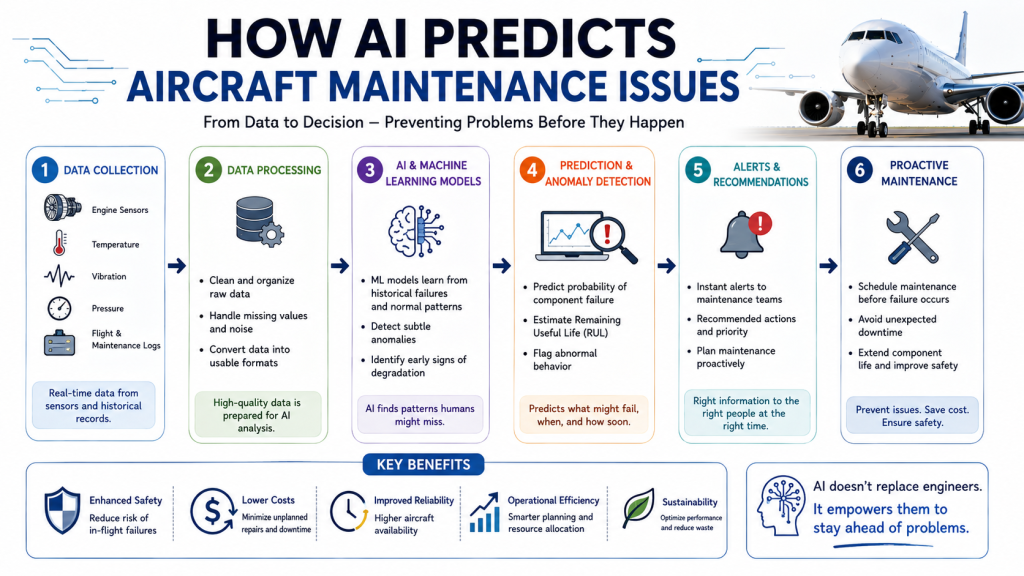
AI-supported predictive maintenance generally follows a sequence of data collection, analysis, pattern recognition, and human review.
Step 1: Collecting Operational Data
Aircraft systems and sensors can generate information during operations.
Depending on the system being monitored, this information may relate to performance, temperature, pressure, vibration, operational cycles, or other measurable conditions.
The purpose of collecting this information is to create a record of how equipment behaves over time.
A single measurement may not always provide useful information. Trends across many observations can provide a clearer picture of changing conditions.
Step 2: Organizing and Preparing the Data
Raw information can come from multiple systems and formats.
Before meaningful analysis takes place, the data may need to be:
- Cleaned.
- Structured.
- Validated.
- Standardized.
- Categorized.
For example, a model may need to distinguish between normal operational variation and inaccurate sensor readings.
Data preparation helps ensure that the analysis is based on useful and relevant information.
Step 3: Learning Normal Operating Patterns
An AI or machine learning system can analyze historical and operational information to identify patterns associated with normal equipment behavior.
For example, a component may normally operate within a particular pattern under certain conditions.
The system can learn how different variables relate to one another.
This is important because equipment behavior can change depending on operating conditions. A measurement that appears unusual in one situation may be normal in another.
The ability to analyze multiple factors together can help create a more detailed understanding of operational patterns.
Step 4: Detecting Unusual Changes
Once a system has a model of expected behavior, it can compare new data with previous patterns.
If the system identifies a significant deviation, it may classify the change as an anomaly or unusual trend.
An anomaly does not automatically mean that a component has failed.
It simply means the available data shows behavior that may require further investigation.
For example, a gradual change in a performance trend may be flagged even when the component continues to operate.
Early identification gives maintenance personnel an opportunity to review the information.
Step 5: Comparing Current and Historical Data
Historical information is important because it provides context.
AI systems can compare current behavior with:
- Previous operating patterns.
- Historical maintenance events.
- Similar component data.
- Long-term performance trends.
This comparison can help identify whether a change is temporary or part of a developing pattern.
However, the usefulness of such comparisons depends on the quality and relevance of the available data.
Step 6: Estimating Potential Maintenance Needs
After identifying unusual patterns, a predictive model may estimate the possibility that a component requires additional attention.
The system may help prioritize components for inspection or suggest that maintenance teams review a developing trend.
This does not mean the AI system can guarantee that a failure will occur.
Predictions are analytical assessments based on available data, assumptions, and model design.
Maintenance personnel must still evaluate the information using approved technical procedures.
Step 7: Supporting Human Maintenance Decisions
The final and most important step involves human expertise.
AI-generated insights can help maintenance teams identify areas that deserve attention, but qualified personnel must interpret the information.
Maintenance actions must follow:
- Approved procedures.
- Technical documentation.
- Applicable regulations.
- Established safety practices.
AI can provide information, but it does not remove the need for professional judgment.
Practical Explanation: Example of AI-Supported Predictive Maintenance
Consider a simplified hypothetical situation involving an aircraft component monitored during regular operations.
The component normally produces a consistent pattern of performance data.
Over time, sensors begin recording a gradual change.
The change is small and may not immediately trigger a traditional fixed-limit warning.
An AI-supported system analyzes the information and compares it with previous data.
The process may look like this:
- Sensors collect operational information during aircraft use.
- The information is stored and prepared for analysis.
- Current data is compared with expected performance patterns.
- The AI model identifies a gradual unusual trend.
- The system flags the trend for further review.
- Maintenance personnel examine the available information.
- Appropriate inspection or maintenance decisions are made using approved procedures.
The AI system has not independently diagnosed or repaired the aircraft.
Instead, it has helped identify a pattern that may deserve earlier attention.
This is a simplified example. Real aircraft maintenance decisions depend on the specific system, technical documentation, operational conditions, approved procedures, and qualified personnel.
AI Predictive Maintenance Process
| Stage | What Happens | Maintenance Value |
|---|---|---|
| Data collection | Operational and maintenance information is gathered | Creates a record of equipment behavior |
| Data preparation | Information is cleaned and organized | Improves analysis quality |
| Pattern analysis | Normal and historical trends are examined | Provides operational context |
| Anomaly detection | Unusual changes are identified | Highlights areas for review |
| Historical comparison | Current data is compared with previous records | Helps identify developing trends |
| Prediction or risk estimation | Models estimate potential maintenance concerns | Supports maintenance planning |
| Human review | Qualified personnel assess the information | Ensures appropriate decisions and procedures |
Common Misunderstandings About AI in Aircraft Maintenance
AI Can Completely Replace Aircraft Maintenance Engineers
AI can process large amounts of information quickly, but it does not replace qualified maintenance professionals.
Maintenance work requires technical knowledge, practical inspection, professional judgment, and compliance with approved procedures.
AI can support these activities by providing additional analytical information.
AI Can Predict Every Failure Perfectly
No predictive system can guarantee that every technical problem will be identified before it occurs.
Predictions depend on factors such as data quality, model design, available historical information, and operating conditions.
AI outputs should therefore be treated as analytical support rather than certainty.
Every Aircraft Data System Uses Artificial Intelligence
Many aircraft systems collect data and provide automated alerts without using advanced AI.
Traditional monitoring systems may operate using predefined thresholds and programmed rules.
AI-based analysis represents an additional approach rather than a description for every automated system.
An AI Warning Always Means a Component Has Failed
An unusual pattern does not automatically confirm a failure.
The data may reflect changes in operating conditions, sensor issues, temporary variation, or a developing technical concern.
Further investigation is necessary before reaching a maintenance conclusion.
More Data Always Means Better Predictions
Large amounts of poor-quality data do not automatically create better results.
Relevant, accurate, consistent, and properly interpreted data is more valuable than simply collecting maximum amounts of information.
AI Can Ignore Maintenance Regulations
AI systems must operate within established aviation maintenance frameworks.
Maintenance activities still require compliance with applicable regulations, approved technical documentation, and organizational procedures.
Technology does not remove these responsibilities.
AI Makes Human Expertise Unnecessary
Human expertise remains essential.
Maintenance professionals understand aircraft systems, operating conditions, inspection procedures, and technical documentation.
AI may identify a pattern, but professionals are required to interpret its practical meaning.
AI Systems Never Make Errors
AI models can produce inaccurate or incomplete outputs.
Their performance can be affected by poor data, incorrect assumptions, changing operational conditions, and limitations in the model itself.
For this reason, AI systems require appropriate monitoring and validation.
Traditional Monitoring and AI-Supported Predictive Maintenance
| Area | Traditional Monitoring | AI-Supported Predictive Maintenance |
|---|---|---|
| Data analysis | Often based on defined limits and rules | Can analyze patterns across multiple data sources |
| Pattern recognition | Focuses on programmed conditions | Can identify complex or developing trends |
| Historical comparison | May be limited depending on the system | Can analyze larger historical datasets |
| Detection of unusual trends | Often identifies threshold exceedances | May identify deviations before fixed limits are reached |
| Maintenance planning support | Based on schedules, inspections, and monitoring results | Can provide additional data-driven insights |
| Human involvement | Required for interpretation and action | Remains essential for interpretation and decisions |
| Limitations | May not identify all developing trends | Depends heavily on data quality and model reliability |
Important Considerations
Data Quality Is Essential
Predictive maintenance systems depend on the information they receive.
If sensor readings are inaccurate or maintenance records are incomplete, AI analysis may become less reliable.
Data quality should therefore be treated as a fundamental part of the system rather than an afterthought.
AI Predictions Are Not Guarantees
A prediction is not the same as a confirmed technical finding.
AI may identify a pattern suggesting that further investigation is appropriate, but the actual condition of a component must be evaluated through proper maintenance processes.
Human Expertise Remains Important
AI can analyze information, but it does not replace technical understanding.
Qualified professionals are needed to interpret findings and determine whether further inspection or maintenance action is necessary.
Aviation Maintenance Requires Approved Procedures
Aircraft maintenance is a controlled technical activity.
AI-generated insights must be used within established maintenance systems and cannot replace approved technical procedures.
Any maintenance action must follow the appropriate documentation and applicable requirements.
Cybersecurity and Data Protection Matter
Connected systems create additional considerations related to data security.
Maintenance information and connected digital systems should be protected against unauthorized access, manipulation, and other cybersecurity risks.
Reliable data is important for both operational analysis and system integrity.
Explainability Can Be Important
Maintenance professionals may need to understand why a system identified a particular trend.
A result is more useful when technical teams can examine the factors that contributed to the alert.
Clear explanations can help professionals evaluate whether the identified pattern is operationally meaningful.
AI Systems Require Monitoring
Operational environments can change over time.
Aircraft equipment, data sources, and maintenance practices may also change.
AI models may therefore require regular evaluation to ensure they continue to provide useful results.
Technology Should Support Safety
The purpose of predictive technology should be to improve awareness and provide useful information.
It should support established safety and maintenance processes rather than bypass them.
The most effective use of AI combines technology with professional expertise and disciplined procedures.
Frequently Asked Questions
1. What is predictive maintenance in aviation?
Predictive maintenance is an approach that uses available equipment and operational information to identify patterns that may indicate a developing maintenance concern before it becomes more significant.
2. How does AI help predict aircraft maintenance issues?
AI can analyze large amounts of sensor, operational, and historical maintenance data to identify unusual patterns or trends that may require further investigation.
3. What type of aircraft data can AI analyze?
Depending on the system, AI may analyze sensor information, component performance data, operational records, historical maintenance information, inspection reports, and environmental conditions.
4. Can AI predict every aircraft component failure?
No. AI predictions are not guarantees. Their usefulness depends on available data, model quality, operating conditions, and the type of issue being analyzed.
5. Does AI replace aircraft maintenance engineers?
No. AI can support data analysis and identify patterns, but qualified maintenance professionals remain essential for inspection, interpretation, and maintenance decisions.
6. What is anomaly detection in predictive maintenance?
Anomaly detection involves identifying data patterns that differ significantly from expected or historical behavior. An anomaly may require investigation but does not automatically confirm a component failure.
7. Why is data quality important for AI predictions?
AI models depend on the information they receive. Inaccurate, incomplete, or inconsistent data can reduce the reliability and usefulness of analytical results.
8. Can AI help reduce unexpected maintenance events?
AI-supported analysis may help identify developing trends earlier, giving maintenance teams additional information for planning and investigation. However, it cannot guarantee that all unexpected maintenance events will be prevented.
9. Are all aircraft maintenance monitoring systems based on AI?
No. Many monitoring systems use conventional automation, predefined thresholds, and programmed rules. AI-based systems are only one approach to analyzing maintenance-related information.
10. What are the limitations of AI in aviation maintenance?
Limitations can include poor data quality, incomplete historical information, changing operating conditions, model errors, and difficulty interpreting complex outputs. AI must therefore be used alongside human expertise and established maintenance procedures.
Conclusion
Artificial intelligence can support aircraft maintenance by analyzing operational information, historical records, and performance patterns that may be difficult to review manually at scale. Through pattern recognition and anomaly detection, AI systems can help identify unusual trends that deserve further investigation.
The predictive process generally begins with reliable data collection and preparation. AI models can then compare current behavior with historical patterns and estimate whether a developing trend may require additional attention.
However, AI predictions are not guarantees and should not be confused with confirmed maintenance findings. The quality of data, design of the analytical model, and changing operating conditions can all influence the results.
Qualified maintenance professionals remain central to the process. AI can provide useful decision-support information, but inspections, maintenance actions, and technical decisions must continue to follow approved procedures and established aviation practices.
When used responsibly, AI can become a valuable tool for improving maintenance awareness and supporting earlier identification of potential issues while working alongside reliable data, human expertise, and disciplined maintenance systems.