Introduction
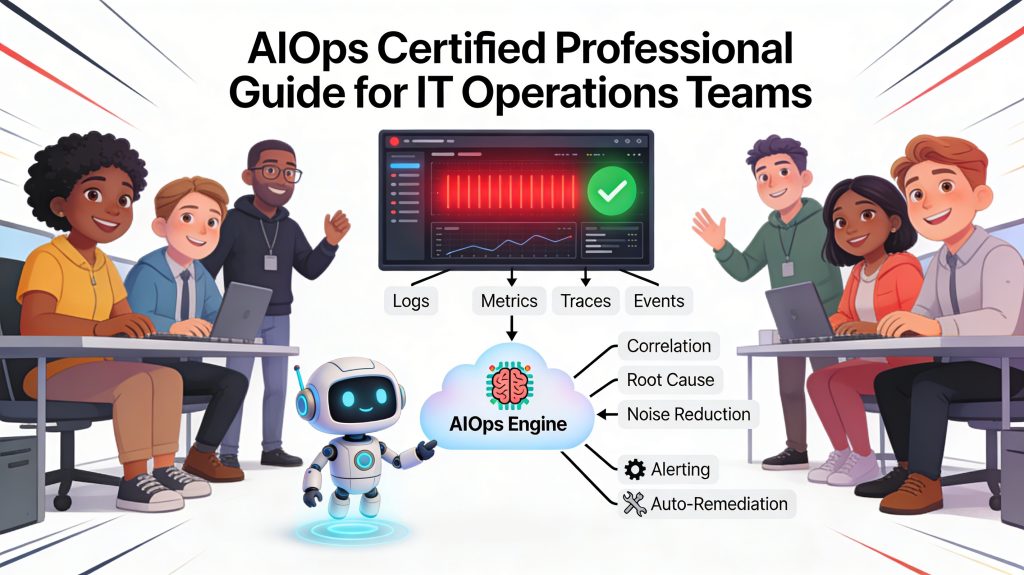
Technology is evolving rapidly, and IT operations are no longer limited to monitoring dashboards and fixing issues manually. Modern systems generate huge amounts of data every second — logs, metrics, traces, and events. Without intelligent analysis, this data becomes noise. Organizations now need professionals who can convert operational data into actionable insights, predict failures before they happen, and automate recovery. This shift has created strong demand for AIOps (Artificial Intelligence for IT Operations) skills.
The AiOps Certified Professional (AIOps) certification is designed to prepare engineers and managers for this transformation. Instead of focusing only on tools, it teaches how intelligent automation, machine learning, and observability work together to improve reliability, performance, and operational efficiency. This guide explains the certification from a practical and career-focused perspective—what you will learn, how it helps in real environments, and how it fits into long-term technology careers.
Understanding the Role of AIOps in Modern IT
In traditional operations, teams react after problems occur. Alerts fire, engineers investigate logs, and recovery takes time. With AIOps, systems become smarter. They learn patterns, detect anomalies, reduce noise, and suggest or trigger automated actions. Instead of reactive firefighting, operations become predictive and proactive.
AIOps helps organizations:
- Detect issues earlier
- Reduce downtime and alert fatigue
- Improve system stability
- Automate incident response
- Optimize performance using data
This is why companies are investing heavily in AIOps-driven operations and seeking professionals who understand both operations and intelligence.
Comparison Table (AIOps vs Related Tracks)
| Category | AIOps Certified Professional (AIOps) | DevOps Track | DevSecOps Track | SRE Track | MLOps Track | DataOps Track | FinOps Track |
|---|---|---|---|---|---|---|---|
| Primary Goal | Use AI/ML to improve IT operations | Faster delivery through automation | Secure delivery with security built-in | Reliable systems with uptime focus | Manage ML model lifecycle | Reliable, automated data pipelines | Cloud cost visibility and optimization |
| Main Focus | Anomaly detection, correlation, prediction, automation | CI/CD, IaC, containers, pipelines | Security scanning, policy, compliance automation | SLOs, incident mgmt, reliability engineering | Training, deployment, monitoring of models | Data quality, orchestration, governance | Budgets, tagging, optimization, chargeback |
| Typical Data Used | Logs, metrics, traces, events | Build + deploy data, infra state | Security events, scan reports | SLIs, logs, latency, error rates | Features, model metrics, drift signals | Pipeline logs, data quality metrics | Usage + billing data, cost metrics |
| Key Outcomes | Reduce alert noise, predict failures, faster RCA | Faster releases, stable deployments | Lower risk, fewer security gaps | Better uptime, predictable performance | Stable ML in production | Trustworthy data delivery | Lower cloud spend, better governance |
| Best Fit Roles | AIOps Engineer, SRE, Platform/Cloud Ops | DevOps Engineer, Platform Engineer | Security Engineer, DevSecOps Engineer | SRE, Reliability Engineer | ML Engineer, MLOps Engineer | Data Engineer, Analytics Engineer | FinOps Practitioner, Cloud Ops, Managers |
| Prerequisites | Monitoring + Ops basics, data thinking | Dev + Ops basics | DevOps + security fundamentals | Linux, networking, monitoring | Python + ML basics | Data pipeline basics | Cloud billing + cost basics |
| Tools Mindset | Intelligence + automation-first | Automation-first | Security-first automation | Reliability-first practices | ML lifecycle automation | Data lifecycle automation | Cost governance + optimization |
| When to Choose | When ops data is too big and noisy | When delivery speed is main goal | When security must be integrated early | When reliability and SLAs are critical | When ML models must run in production | When data pipelines must be dependable | When cloud costs need control |
| How AIOps Adds Value | Turns ops data into predictive actions | Adds intelligence to monitoring & response | Adds anomaly detection to security ops | Adds prediction + correlation to incidents | Adds ops intelligence to ML monitoring | Adds anomaly detection to pipeline health | Adds predictive insights to cost spikes |
AiOps Certified Professional (AIOps)
What it is
This certification focuses on using Artificial Intelligence and Machine Learning to improve IT operations. It teaches how to analyze operational data, detect abnormal behavior, predict failures, and automate recovery.
Who should take it
- DevOps and Platform Engineers
- SRE and Reliability Engineers
- Cloud and Infrastructure Engineers
- Operations and Support Teams
- Engineering and Technology Managers
Skills you’ll gain
After completing the AiOps Certified Professional (AIOps), you learn how to use AI and automation to make IT operations smarter, faster, and more reliable by detecting issues early, predicting failures, and automating responses.
- Understanding AIOps architecture
- Applying ML in operations
- Observability and intelligent monitoring
- Anomaly detection and pattern analysis
- Event correlation and alert optimization
- Predictive incident detection
- Data-driven root cause analysis
- Automation and self-healing systems
Real-world projects you should be able to do
After completing the AiOps Certified Professional (AIOps), you should be able to apply intelligent automation and data-driven operations in real production environments to improve reliability, reduce noise, and speed up incident response.
- Create automated alert correlation engine
- Build anomaly detection from operational data
- Predict system failures using historical trends
- Automate incident detection and remediation
- Reduce alert noise using intelligent filtering
- Implement automated root cause analysis
- Build self-healing scripts for common failures
- Design AIOps-based monitoring workflow
Preparation Plan
A structured preparation helps you understand AIOps concepts clearly and apply them in real scenarios. Choose a timeline based on your experience and learning pace.
7–14 Days (Fast Track)
Focus on core AIOps concepts, observability basics, anomaly detection, and automation fundamentals. Ideal if you already have DevOps or SRE experience.
30 Days (Balanced)
Study AIOps tools in depth, practice analyzing logs and metrics, build a small anomaly detection example, and learn event correlation and predictive monitoring.
60 Days (Advanced)
Work on real-world implementation. Build a complete AIOps pipeline, practice with incident datasets, implement alert correlation, and create self-healing automation for common system failures.
Common mistakes
- Treating AIOps as only a tool, not a concept
- Ignoring data quality and monitoring fundamentals
- Learning theory without real practice
- Expecting AI to solve all operational issues
- Not understanding observability properly
Best next certification after this
- Same track: Advanced AIOps / MLOps
- Cross track: SRE Certified Professional
- Leadership: DevOps Architect / Engineering Manager
Choose Your Path
Below are simple learning paths showing how different professionals can naturally progress toward AiOps Certified Professional (AIOps) based on their background and career goals.
DevOps Path
Start → DevOps Fundamentals → CI/CD → Containers → Monitoring → AIOps
Best for DevOps engineers who want to add intelligence and predictive automation to their delivery and operations workflow.
DevSecOps Path
Start → DevOps Basics → Security Automation → DevSecOps → Observability → AIOps
Ideal for professionals focusing on secure and automated systems. AIOps strengthens threat detection, anomaly identification, and intelligent response.
SRE Path
Start → Linux → Monitoring → Reliability → Incident Management → AIOps
Designed for reliability-focused engineers. AIOps enhances incident detection, prediction, and self-healing capabilities.
AIOps / MLOps Path
Start → Python → ML Basics → Observability → AIOps → AIOps → MLOps
Suitable for professionals interested in AI-driven operations. After applying AIOps, you can extend into full MLOps lifecycle and automation.
DataOps Path
Start → Data Pipelines → Observability → Data Quality → AI in Ops → AIOps
Best for data professionals who want to apply analytics and machine learning in operational environments.
FinOps Path
Start → Cloud → Cost Monitoring → Optimization → Predictive Analytics → AIOps
Ideal for cloud cost and optimization roles. AIOps helps predict usage anomalies, optimize cost patterns, and automate governance.
Role → Recommended Certifications
| Role | Recommended Certifications |
|---|---|
| DevOps Engineer | DevOps → Kubernetes → Monitoring → AIOps |
| SRE | Reliability → Observability → AIOps |
| Platform Engineer | Kubernetes → Automation → Observability → AIOps |
| Cloud Engineer | Cloud → Monitoring → Automation → AIOps |
| Security Engineer | DevSecOps → Security Monitoring → AIOps |
| Data Engineer | DataOps → ML Basics → AIOps |
| FinOps Practitioner | FinOps → Cost Analytics → AIOps |
| Engineering Manager | DevOps Manager → SRE → AIOps |
Next Certifications to Consider
Same Track
- Advanced AIOps / MLOps
Cross Track
- SRE Certified Professional
Leadership
- DevOps Architect / Technology Manager
Career Perspective of AIOps
AIOps is becoming a core capability in modern IT operations. Organizations are moving from manual monitoring to predictive and automated systems. Professionals who understand how to combine operations, automation, and AI are highly valuable. After this certification, you are prepared to design intelligent operations, reduce operational risks, and improve system reliability using data-driven insights.
Training & Certification Support Institutions
DevOpsSchool
provides structured learning with practical labs, real-world projects, and certification guidance for professionals entering AIOps-driven operations.
Cotocus
focuses on enterprise-level training and consulting, helping professionals apply AIOps in real production environments.
ScmGalaxy
emphasizes automation and intelligent operations with strong hands-on learning and troubleshooting exposure.
BestDevOps
delivers industry-aligned training with practical implementation and real-world scenario-based learning.
devsecopsschool.com
A training and learning platform focused on DevSecOps. It helps professionals learn how to integrate security into DevOps pipelines using automation. It typically covers secure CI/CD, vulnerability scanning, policy as code, container security, cloud security basics, and how to reduce security risks without slowing delivery.
sreschool.com
A learning platform focused on Site Reliability Engineering (SRE). It teaches how to build reliable systems using SLO/SLA/SLI, monitoring, incident response, on-call practices, error budgets, capacity planning, and reliability engineering methods that improve uptime and system stability.
aiopsschool.com
A learning platform focused on AIOps (AI for IT Operations). It helps professionals understand how AI and machine learning are used in operations for anomaly detection, event correlation, alert noise reduction, predictive monitoring, faster root cause analysis, and automation for self-healing systems.
dataopsschool.com
A learning platform focused on DataOps. It supports professionals working on data engineering and analytics pipelines by teaching data pipeline automation, orchestration, data quality checks, version control for data workflows, monitoring data systems, and making data delivery reliable and repeatable.
finopsschool.com
A learning platform focused on FinOps (Cloud Financial Operations). It teaches cloud cost visibility and optimization through budgeting, tagging standards, governance, chargeback/showback models, usage optimization, forecasting, and controlling cloud spending without blocking engineering speed.
Frequently Asked Questions
1. Is AIOps certification hard?
Moderate difficulty, easier with DevOps basics.
2. How long to prepare?
Usually 30–60 days.
3. Do I need ML knowledge?
Basic understanding helps but not mandatory.
4. Who should take it?
Engineers working in DevOps, SRE, Cloud, or Operations.
5. Is it valuable for career?
Yes, demand is growing globally.
6. Does it require coding?
Basic scripting is enough.
7. Biggest benefit?
Predictive operations and intelligent automation.
8. Can beginners take it?
Yes, but fundamentals are recommended.
9. What roles after certification?
AIOps Engineer, SRE, DevOps, Platform Engineer.
10. Does AIOps replace DevOps?
No, it enhances DevOps.
11. Is hands-on required?
Yes, practical experience is essential.
12. Is it useful for managers?
Yes, helps improve operational efficiency.
FAQs on AiOps Certified Professional (AIOps)
1. What is AIOps certification?
It validates skills in applying AI to IT operations.
2. Is it recognized globally?
Yes, widely valued in modern operations roles.
3. What are prerequisites?
Basic DevOps, Linux, and monitoring knowledge.
4. How does it help in real work?
Improves monitoring, automation, and predictive analysis.
5. What tools are included?
Observability, automation, and ML-driven operations tools.
6. Can it improve salary?
Yes, AIOps skills are in demand.
7. What does exam focus on?
Concepts, automation, anomaly detection, and real use cases.
8. Is it worth doing?
Yes, it prepares you for future intelligent operations.
Conclusion
IT operations are shifting toward intelligent, automated, and predictive systems. Manual troubleshooting is no longer enough for modern distributed environments. The AiOps Certified Professional (AIOps) certification prepares professionals to manage this shift by combining AI, automation, and observability into practical skills. It helps reduce downtime, improve performance, and build smarter systems that can detect and respond to issues automatically.
As organizations continue adopting intelligent operations, professionals with AIOps expertise will remain highly valuable. This certification provides a strong foundation for future-ready careers in DevOps, SRE, and modern cloud operations, helping you stay ahead in an increasingly data-driven technology landscape.