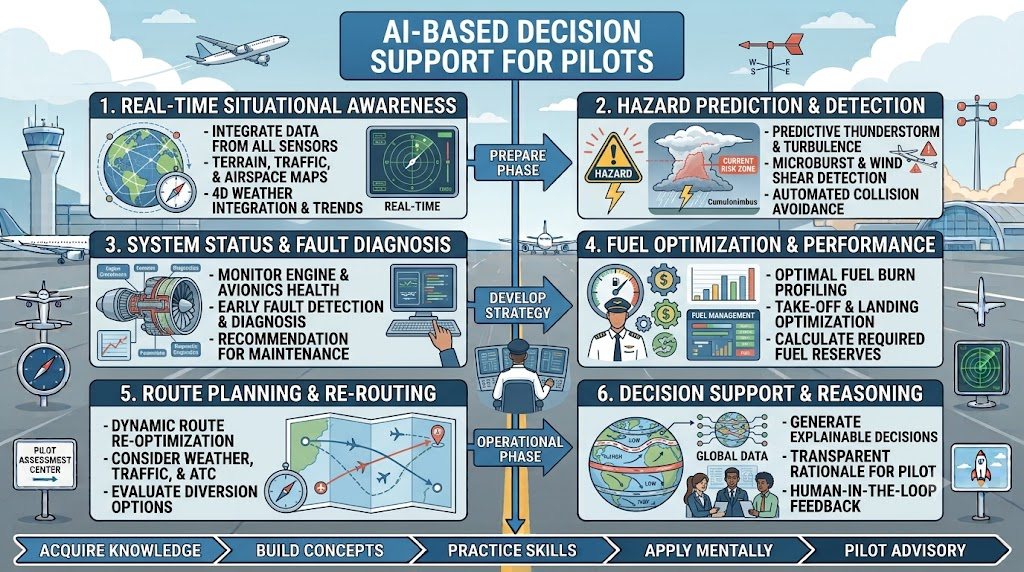
Introduction
Artificial intelligence is becoming increasingly relevant to aviation as aircraft and flight operations generate large amounts of information. Pilots may need to consider weather, aircraft data, route conditions, air traffic, and operational information while managing a flight. AI-based decision support can help organize and analyze some of this information and highlight patterns that may deserve attention. However, AI is best understood as a tool that supports human judgment rather than a replacement for the pilot.
Main Content
What Is AI-Based Decision Support?
AI-based decision support refers to technology that uses artificial intelligence techniques to analyze information and provide useful outputs to a human decision-maker.
In aviation, such systems may process information from multiple sources and present the results in a way that helps pilots understand changing conditions.
Depending on the system, AI may be used for:
- Pattern recognition.
- Data analysis.
- Anomaly detection.
- Risk identification.
- Prediction.
- Information prioritization.
- Decision recommendations.
The purpose is not necessarily to make the decision for the pilot. Instead, the system can help reduce the amount of information a pilot has to process manually.
This distinction is important. Decision support and autonomous decision-making are not the same thing.
A decision-support system may identify a potential issue and bring it to the pilot’s attention. The pilot then evaluates the information alongside other available data and applicable procedures.
Why Pilots Need Decision Support
Modern aviation involves the continuous flow of information.
During a flight, pilots may need to consider weather conditions, aircraft performance, navigation information, air traffic, fuel status, airport conditions, and operational factors.
Under normal conditions, pilots are trained to manage this information. However, workload can increase when conditions change unexpectedly or when several events occur at the same time.
AI-based tools may help by processing selected information and identifying patterns that could otherwise take more time to detect.
For example, a system might monitor changing weather information and highlight a developing area of significant weather along a planned route.
The system does not need to make the final decision. Its role can simply be to ensure that relevant information receives appropriate attention.
How Artificial Intelligence Can Support Pilots
Pattern Recognition
One of the strengths of AI systems is their ability to identify patterns in large datasets.
A machine-learning model can be trained using relevant historical or operational data and may then identify patterns in new information.
In aviation, pattern recognition could potentially be used for areas such as aircraft monitoring, weather analysis, and operational data.
However, recognizing a pattern does not necessarily mean understanding its complete context.
Human evaluation remains important, particularly when the situation is unusual or outside the conditions represented in the system’s training data.
Data Analysis
AI can process large quantities of information quickly.
A pilot may receive information from several systems, while an AI-based tool can potentially analyze selected datasets continuously.
This can help organize information and identify changes that may require attention.
The benefit is not simply speed. Another advantage is the ability to monitor information consistently without becoming tired or distracted.
Risk Identification
AI systems may also be designed to identify patterns associated with potential risks.
For example, a system could analyze aircraft data and highlight an unusual trend.
Similarly, an AI-based weather tool could identify changing conditions that deserve further examination.
However, an identified risk is not necessarily a confirmed problem.
AI outputs should therefore be treated as information for evaluation rather than unquestionable conclusions.
AI and Weather Analysis
Weather is one area where AI-based analysis may provide useful decision support.
Weather information can come from multiple sources, and conditions can change over time.
AI systems may potentially help organize information relating to:
- Weather patterns.
- Turbulence.
- Visibility.
- Wind.
- Precipitation.
- Significant weather areas.
- Changing atmospheric conditions.
For example, an AI system could analyze changing weather information along a planned route and highlight areas where conditions may require additional attention.
This does not mean AI can predict every weather event accurately.
Weather remains a complex and changing natural system. The quality and usefulness of any AI output depend on the underlying data, model, and operating conditions.
The pilot still needs to consider official weather information, applicable procedures, and the overall operational situation.
AI for Flight Planning
Flight planning involves considering several factors simultaneously.
AI-based tools may potentially assist by analyzing:
- Route options.
- Weather information.
- Fuel-related considerations.
- Airport conditions.
- Operational constraints.
- Expected changes along the route.
For example, an AI system could compare available information and highlight a route segment where weather conditions are expected to become more significant.
The system may then present possible alternatives for human evaluation.
The important point is that AI-based flight-planning support should not be treated as an automatic replacement for established flight-planning processes.
Actual planning must follow applicable regulations, procedures, aircraft limitations, and operational requirements.
AI and Aircraft Health Monitoring
Aircraft generate large quantities of technical data.
AI and machine-learning systems can potentially analyze this information to identify unusual patterns.
For example, if a particular aircraft parameter begins behaving differently from its normal pattern, an AI-based monitoring system might highlight the change.
This can support early awareness of a potential issue.
However, there is an important difference between detecting an anomaly and diagnosing a confirmed technical fault.
An AI system may identify something unusual without knowing exactly why it occurred.
Qualified personnel and approved technical procedures remain necessary for maintenance assessment and aircraft-related decisions.
AI-Based Risk Identification
AI can also be used to support broader operational risk analysis.
A system may analyze information from multiple sources and identify combinations of factors that deserve attention.
Potential areas include:
- Unusual aircraft data.
- Changing weather.
- Route-related concerns.
- Operational conflicts.
- Unexpected changes in conditions.
- Patterns associated with previous events.
This can help pilots focus their attention on information that may be important.
However, AI should not be treated as an authority that determines whether a flight is safe.
Risk is contextual. A pilot may have information that is not available to the AI system, and a recommendation may not account for every operational consideration.
AI in the Cockpit
AI-based technology could potentially become more closely integrated with cockpit information systems.
Possible applications include:
- Information summarization.
- Intelligent alerts.
- Voice-based assistance.
- Data visualization.
- Anomaly identification.
- Decision recommendations.
- Situational awareness support.
The exact capabilities depend on the aircraft, system design, certification, and operational environment.
It is therefore incorrect to assume that every modern aircraft has the same AI capabilities.
Some technologies may be experimental, some may be used for specific operational purposes, and others may still be under development.
AI and Situational Awareness
Situational awareness means understanding what is happening, what may happen next, and what actions may be required.
Pilots develop situational awareness by combining information from instruments, communication, navigation systems, weather information, aircraft behavior, and their understanding of the operating environment.
AI may support this process by organizing information and identifying significant changes.
For example, instead of requiring a pilot to examine numerous data points individually, an AI-based interface could highlight a developing trend.
However, too many alerts can create another problem.
If a system produces excessive warnings, pilots may find it more difficult to identify which information is genuinely important.
Good system design therefore needs to balance useful alerts with the risk of information overload.
Practical Explanation: How AI Decision Support Could Work During a Flight
Consider a simplified example.
A jet is flying along its planned route when weather conditions begin changing.
An AI-based decision-support system could receive relevant weather and operational information and analyze the changes.
The system might identify an area of potentially significant weather and bring it to the pilot’s attention.
The pilot could then review the information using other available sources.
The AI system might present possible route alternatives or summarize relevant changes.
The pilot evaluates those options while considering the aircraft, weather, operational requirements, air traffic situation, and applicable procedures.
The final decision remains a human responsibility within the applicable operating framework.
The simplified process could look like this:
- Relevant information is collected.
- The AI system analyzes the information.
- A potentially important pattern is identified.
- The system presents an alert or recommendation.
- The pilot evaluates the information.
- The pilot considers other available sources.
- An appropriate decision is made according to applicable procedures.
This example illustrates the basic idea of decision support without assuming that every aircraft uses the same technology.
Human Pilot and AI: Working Together
AI and human pilots have different strengths.
AI can process large datasets quickly and monitor selected information continuously.
Pilots, on the other hand, bring experience, contextual understanding, communication skills, judgment, and responsibility.
AI Can Help With
- Processing large quantities of data.
- Detecting patterns.
- Monitoring selected parameters.
- Identifying anomalies.
- Presenting information.
- Generating analytical recommendations.
Pilots Provide
- Contextual judgment.
- Operational experience.
- Understanding of the complete situation.
- Communication with other aviation personnel.
- Evaluation of competing priorities.
- Final human responsibility within the applicable operational framework.
This combination is often described as human-machine collaboration.
The goal is not necessarily to make pilots do less thinking. Instead, well-designed decision-support systems can help pilots focus their attention where human judgment is most valuable.
Potential AI Applications in Aviation
| AI Application | What It Can Support | Potential Benefit |
|---|---|---|
| Weather analysis | Processing changing weather information | Helps highlight potentially significant conditions |
| Flight planning | Comparing route and operational information | Supports analysis of possible options |
| Aircraft health monitoring | Identifying unusual technical patterns | Can support earlier awareness of anomalies |
| Risk identification | Analyzing combinations of operational information | Helps bring potential concerns to attention |
| Situational awareness | Organizing multiple information sources | Can reduce information overload |
| Information management | Summarizing or prioritizing selected data | Helps pilots focus on relevant information |
Benefits and Limitations of AI Decision Support
AI-based decision support can offer several potential advantages, but its limitations are equally important.
Potential Benefits
Faster Data Analysis
AI can process large quantities of information quickly, allowing relevant patterns to be identified without requiring every piece of information to be reviewed manually.
Continuous Monitoring
A properly designed system can monitor selected information continuously and identify changes that may deserve attention.
Improved Information Organization
AI may help organize complex information into a more understandable format.
Early Anomaly Detection
Machine-learning systems can potentially recognize patterns that differ from expected behavior.
Support During High Workload
When workload increases, organized decision support may help pilots maintain awareness of important information.
Important Limitations
AI is not infallible.
Poor-quality data can lead to poor outputs. A system may also produce an incorrect recommendation or fail to recognize an unusual situation.
Another concern is that AI models may perform differently when they encounter conditions that differ significantly from the data used to develop them.
There is also the issue of automation bias.
Automation bias occurs when a person places too much trust in an automated system’s recommendation simply because it was produced by technology.
This can become dangerous if the human decision-maker stops questioning an output.
AI systems can also generate unnecessary alerts. If pilots receive too many alerts, important information may become harder to identify.
For these reasons, AI decision support needs careful design, testing, validation, training, and appropriate human oversight.
Human Decision-Making Compared With AI Support
| Area | AI-Based Support | Human Pilot |
|---|---|---|
| Data processing | Can process large datasets rapidly | Reviews and interprets relevant information |
| Pattern recognition | Can identify patterns within available data | Uses experience and contextual understanding |
| Continuous monitoring | Can monitor selected parameters continuously | Maintains broader situational awareness |
| Contextual judgment | Limited to available data and system design | Can consider broader operational context |
| Risk assessment | Can highlight potential risks | Evaluates significance using judgment and procedures |
| Final decision-making | Provides analysis or recommendations | Makes or confirms decisions within the applicable operational framework |
Important Considerations
Human Oversight
AI-based decision support should be designed around appropriate human involvement.
A pilot needs to understand what the system is showing, why it is relevant, and what its limitations may be.
The technology should support the pilot rather than encourage blind reliance on automated recommendations.
Data Quality
AI systems depend heavily on data.
If the information entering a system is incomplete, outdated, inaccurate, or unsuitable for the task, the resulting output may also be unreliable.
The quality of the model cannot compensate for fundamentally poor information.
Explainability
Pilots may need to understand why an AI system generated a warning or recommendation.
An alert that provides no understandable context may be difficult to evaluate.
Explainability can therefore be an important consideration when designing AI-based aviation systems.
Automation Bias
Technology can influence human behavior.
If pilots become overly confident in an automated system, they may accept its recommendations without sufficient independent evaluation.
Training and system design can help reduce this risk.
False Alerts
An AI system may sometimes identify something that appears significant but turns out not to be operationally important.
Too many false alerts can increase workload and reduce confidence in the system.
AI-based tools therefore need to balance sensitivity with useful and meaningful information.
Cybersecurity
Connected aviation systems must also consider cybersecurity.
Communication between systems, data exchange, and connected technologies create additional considerations for protecting aviation systems from unauthorized access or interference.
Cybersecurity should be handled through appropriate aviation security and engineering practices.
Pilot Training
Pilots using AI-assisted systems need to understand both their capabilities and their limitations.
Training should not focus only on how to operate the interface. It should also explain situations where the system may be unreliable or where human judgment needs to take priority.
Regulations and Certification
AI-based aviation systems involve technical, safety, operational, and regulatory considerations.
The specific requirements depend on the technology and how it is used.
Aviation regulations and certification requirements can change, so current official information should be used when discussing specific regulatory matters.
Frequently Asked Questions
1. What is AI-based decision support for pilots?
AI-based decision support uses artificial intelligence to analyze information and provide pilots with alerts, patterns, predictions, summaries, or recommendations that may help with decision-making.
2. Can AI replace pilots?
AI-based decision support should not be understood as a replacement for pilots. Its role is generally to support human decision-making, while the pilot remains responsible for evaluating information within the applicable operational framework.
3. How can AI help pilots analyze weather?
AI can potentially process large amounts of weather information and identify patterns or changing conditions that may deserve attention. It cannot guarantee perfect weather predictions.
4. Can AI assist with flight planning?
AI can potentially support route analysis, weather evaluation, fuel-related considerations, airport information, and other planning factors. Actual flight planning must follow applicable procedures and requirements.
5. How can AI help identify aircraft problems?
AI-based monitoring systems can analyze aircraft data and identify patterns that differ from expected behavior. Such an alert does not necessarily confirm a technical fault and may require further assessment by qualified personnel.
6. What is automation bias?
Automation bias is the tendency to place excessive trust in an automated system’s recommendation or output. In aviation, appropriate training and human oversight are important for reducing this risk.
7. What are the limitations of AI in aviation?
AI can be affected by poor data, unexpected conditions, model limitations, false alerts, and insufficient context. It can also produce incorrect recommendations.
8. Does AI make the final decision during a flight?
A decision-support system may provide analysis or recommendations, but it should not automatically be assumed to have final decision-making authority. Human involvement and applicable operational procedures remain important.
9. Do pilots need special training to use AI-based systems?
Where AI-based systems are introduced into an operational environment, pilots need appropriate training to understand how the system works, what information it provides, and what its limitations are.
10. What is the future of AI-based decision support in aviation?
AI may become increasingly useful for analyzing information, detecting patterns, monitoring aircraft data, and supporting situational awareness. However, future applications will depend on technology development, validation, safety considerations, certification, regulation, and operational needs.
Conclusion
AI-based decision support has the potential to change how pilots interact with the large amount of information generated during modern flight operations. By analyzing data, recognizing patterns, monitoring selected parameters, and presenting relevant information, AI can potentially help pilots manage complex situations more effectively.
However, AI has important limitations. It depends on the quality of its data, can produce incorrect or unnecessary outputs, and may not understand the complete context of a situation. Excessive reliance on automated recommendations can also create risks such as automation bias.
The most useful approach is to view AI as a decision-support tool rather than a replacement for human judgment. Pilots bring experience, context, communication, and professional judgment that cannot simply be reduced to data processing.
As aviation technology develops, successful AI integration will depend not only on what artificial intelligence can do, but also on how effectively humans and intelligent systems can work together.