Introduction
DevOps is not only about tools. It is about building a delivery system that helps teams ship changes faster, safer, and with less stress. In real companies, delivery becomes slow when builds break often, deployments are risky, environments are different, and production issues take too long to fix.
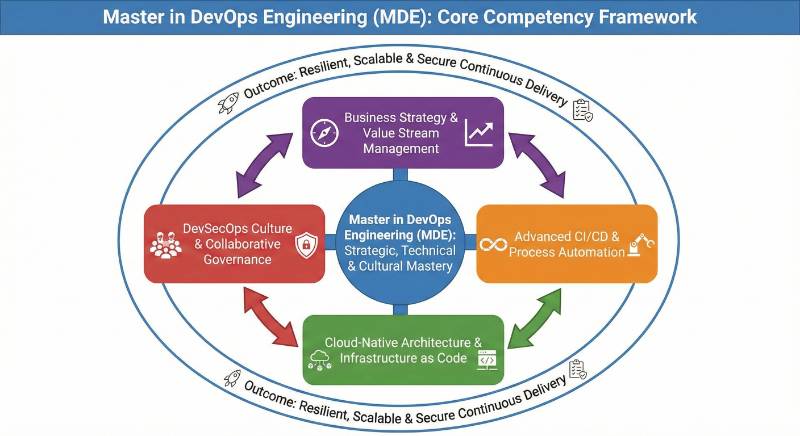
Master in DevOps Engineering (MDE) is designed to help working engineers and managers go deeper than basics. It focuses on real DevOps engineering skills that teams use daily—automation, CI/CD, containers, infrastructure consistency, monitoring, and troubleshooting. This guide explains MDE in simple words and helps you decide if it fits your career plan.
About the Provider
DevOpsSchool is the provider of the Master in DevOps Engineering (MDE) certification program. The learning approach is practical and focused on real workflows, not only theory. It is meant for working professionals who want skills they can apply in projects, releases, and production support.
What Is Master in DevOps Engineering (MDE)?
MDE is a professional-level DevOps certification program that validates your ability to build and run modern DevOps workflows end-to-end. It focuses on delivery automation, repeatable environments, reliable deployments, and production readiness.
Why MDE Matters Today
DevOps roles are growing across India and global teams. But hiring teams do not only want someone who “knows tools.” They want someone who can deliver outcomes: stable pipelines, safe releases, and fast recovery from failures.
MDE helps you build this outcome mindset. It also helps you speak clearly in interviews about real workflows and decisions.
Who should take it
MDE is best for people who want strong, practical DevOps skills that they can use in real projects. It is not only for “DevOps job titles.” It is for anyone who works with software delivery and wants faster, safer releases with better automation and control.
- Working software engineers who want to move into DevOps or Platform roles
- DevOps engineers who want deeper end-to-end mastery
- Cloud engineers who own deployments and environments
- Platform engineers building internal delivery platforms
- Team leads and managers who want better delivery reliability and speed
- Engineers preparing for global DevOps roles and interviews
Skills you’ll gain
- Strong CI/CD pipeline design and automation thinking
- Clean Git workflow understanding for delivery and release control
- Build and test automation fundamentals that reduce release risk
- Container-based delivery understanding (packaging and deployment flow)
- Infrastructure consistency mindset (repeatable environments)
- Monitoring and alerting basics for production confidence
- Troubleshooting skills (logs, pipeline failures, deployment issues)
- Release safety practices (rollback readiness and controlled releases)
- Documentation habits (runbooks, checklists, repeatable steps)
Real-world projects you should be able to do after it
- Build an end-to-end CI/CD pipeline from commit to deployment
- Create a multi-stage pipeline (build → test → quality gates → deploy)
- Containerize an application and run it reliably across environments
- Design a safe deployment approach with rollback planning
- Standardize environment configuration to reduce “works on my machine” issues
- Set up basic monitoring dashboards and alert rules for key services
- Troubleshoot common failures using logs and pipeline feedback
- Create runbooks for releases and common incidents
Preparation plan (7–14 days / 30 days / 60 days)
7–14 days (fast track)
- Refresh DevOps basics: pipeline stages, environments, release flow
- Practice Git daily: branches, merges, tags, release versions
- Build a simple pipeline and run it end-to-end once
- Practice container basics and basic deployment flow
- Write short notes and checklists for repeatable steps
30 days (standard track)
- Build one real project end-to-end and improve it weekly
- Add automated tests and simple quality gates to the pipeline
- Practice deployment to dev/stage-like environments
- Improve Linux basics: processes, permissions, networking, logs
- Add monitoring dashboards and a few meaningful alerts
- Practice fixing failures: broken build, failed deploy, bad config, slow pipeline
60 days (professional track)
- Build a production-style project with rollback planning
- Standardize pipeline templates and document a reuse approach
- Add release controls (approvals, gated deploys, staged promotions)
- Improve troubleshooting skills with incident-style exercises
- Create runbooks and an onboarding checklist for your DevOps setup
- Practice explaining architecture choices like you would in an interview
Common mistakes
- Skipping the Fundamentals: Rushing to tools like Kubernetes without a solid grasp of Linux, networking, and scripting is a path to frustration.
- Tool-Centric Learning: Focusing only on which button to click instead of understanding the underlying why—the principles of automation, collaboration, and feedback loops.
- Neglecting Security (DevSecOps): Treating security as a final gate rather than an integrated part of every stage in the pipeline.
- Underestimating Soft Skills: DevOps is about breaking down silos. Poor communication and collaboration skills will undermine technical excellence.
- Ignoring Real-World Practice: Certifications are validated by doing. Not completing the hands-on labs and live projects means you are not truly prepared.
Best next certification after this
After MDE, your next step depends on your direction:
- Same Track: Certified Kubernetes Administrator (CKA)
- Cross-Track: Certified FinOps Professional (to understand the money side)
- Leadership: Certified DevOps Architect (CDA)
Choose Your Path
Many professionals complete MDE and then choose a focused direction. This makes growth faster and more clear.
- DevOps Path
- You focus on delivery automation, CI/CD maturity, deployment safety, and platform enablement. This path fits engineers owning release outcomes.
- DevSecOps Path
- You focus on adding security into delivery flow: secure pipelines, secrets handling, policy thinking, and risk reduction without slowing releases.
- SRE Path
- You focus on reliability, observability, incident routines, and making production stable. This path fits engineers who enjoy production and uptime.
- AIOps/MLOps Path
- You focus on smarter operations: noise reduction, event correlation, automation using AI methods, and managing ML operations where needed.
- DataOps Path
- You focus on stable data delivery: automated data pipelines, quality checks, and reliable analytics delivery.
- FinOps Path
- You focus on cloud cost control: allocation, optimization, governance, and cost-aware engineering practices.
Role → Recommended Certifications Mapping
Below is a practical mapping to help engineers and managers decide how MDE fits into their role plan.
| Role | Recommended certifications direction |
|---|---|
| DevOps Engineer | DevOps foundation → MDE → architecture or specialization |
| SRE | DevOps foundation → MDE → SRE path for reliability maturity |
| Platform Engineer | DevOps professional skills → MDE → platform and standardization focus |
| Cloud Engineer | Cloud basics → MDE → delivery architecture and safe deployments |
| Security Engineer | DevOps basics → MDE → DevSecOps focus for secure delivery |
| Data Engineer | Data basics → MDE → DataOps focus for reliable pipelines |
| FinOps Practitioner | Cloud usage basics → MDE → FinOps focus for cost governance |
| Engineering Manager | DevOps understanding → MDE → leadership and governance focus |
Career Value of MDE
MDE adds value because it validates the skills that teams depend on daily. It supports both engineers and managers, but in different ways.
For working engineers
You gain confidence in delivery systems. You can build pipelines, package apps, deploy safely, and troubleshoot failures. This makes you stronger in interviews and more effective in real work.
For managers and leads
You understand what a healthy delivery system looks like. You can guide teams on standards, release safety, and measurable improvements. This helps reduce production surprises and delivery delays.
What hiring teams notice
- You can explain end-to-end delivery clearly
- You understand repeatability and environment consistency
- You talk about release safety, not only deployment success
- You can troubleshoot and learn from failures
- You think in workflows and outcomes, not random tools
Next Certifications to Take
You asked for 3 options: same track, cross-track, and leadership. Below is a clean and practical way to think about it, based on common software-engineer certification progressions.
Same track (deeper DevOps mastery)
- Continue deeper into advanced DevOps architecture and platform thinking
- Strengthen cloud-native delivery and scaling skills
- Focus on standardization, reusable templates, and shared platform enablement
Cross-track (specialize based on your daily work)
- DevSecOps if security and compliance are key in your projects
- SRE if reliability, uptime, and production stability are your focus
- DataOps if data pipelines and quality delivery are your main responsibility
- FinOps if your team needs strong cloud cost governance
- AIOps/MLOps if automation and intelligent operations are your direction
Leadership (execution + governance)
- Move toward DevOps leadership and delivery governance
- Focus on metrics, process improvement, team enablement, and predictable releases
Top Institutions That Help with Training + Certifications (MDE)
If you want structured support for MDE preparation, these institutions can help because they focus on practical learning and certification-aligned guidance. The main benefit is clarity: a roadmap, real projects, and consistent practice so your learning stays job-ready.
DevOpsSchool
DevOpsSchool supports structured learning for working professionals and helps build end-to-end DevOps engineering capability. It focuses on practical workflows, project-style learning, and confidence in real delivery tasks.
Cotocus
Cotocus supports industry-focused learning and implementation mindset. It helps learners connect DevOps concepts to real delivery improvements and operational outcomes.
Scmgalaxy
Scmgalaxy supports learning around CI/CD and automation thinking. It helps professionals strengthen the habits needed for stable release pipelines and repeatable delivery.
BestDevOps
BestDevOps supports certification-oriented learning with hands-on focus. It helps learners stay aligned to job skills and interview-ready outcomes.
devsecopsschool.com
This supports security-focused DevOps learning where pipelines need stronger controls. It helps professionals extend DevOps into secure delivery practices.
sreschool.com
This supports reliability-focused learning for engineers working close to production. It helps extend DevOps skills into stability, incident readiness, and observability habits.
aiopsschool.com
This supports AI-driven operations learning for teams dealing with alert noise and large-scale systems. It helps build automation thinking for smarter operations.
dataopsschool.com
This supports DataOps learning for engineers managing data pipelines and delivery reliability. It helps build quality, repeatability, and stable data flow thinking.
finopsschool.com
This supports FinOps learning for cloud cost visibility and governance. It helps teams control spend while keeping delivery speed healthy.
Frequently Asked Questions:
Q1: Is the MDE certification difficult for a beginner?
A: Yes, it can be challenging if you have zero IT experience. However, if you follow the “Roots” phase of the preparation plan (Linux/Networking), it is completely achievable. It requires dedication, not genius.
Q2: How long does it take to complete?
A: For a working professional dedicating 1-2 hours a day, it typically takes 60 to 90 days to be exam-ready and project-competent.
Q3: Do I need coding skills for MDE?
Basic scripting helps, but you do not need deep software development. Practical automation thinking matters most.
Q5: What are the prerequisites?
Basic Git, Linux fundamentals, and a clear understanding of the software delivery flow are very helpful.
Q5: Do I need to be a coder to pass?
A: You do not need to be a software developer, but you must be comfortable with scripting (Python, Bash) and reading code. DevOps is about automation, and automation requires code.
Q6: What is the best learning sequence before MDE?
Start with DevOps basics, then practice CI/CD and containers, then move into deeper workflow and reliability habits.
Q7: Is MDE useful for global jobs?
Yes. DevOps delivery practices are common across India, the US, Europe, and remote teams.
Q8: Will MDE help me become a Platform Engineer?
Yes. MDE supports skills like standard pipelines, repeatable setups, and platform thinking.
Q9: What is the career outcome?
A: MDE holders often move into roles like Senior DevOps Engineer, SRE, or Cloud Architect. The salary hike for certified professionals in India and globally is often between 30-40% post-certification.
Q10: What kind of projects should I build for MDE?
Build a pipeline that deploys an app safely, add monitoring, and practice failure recovery. One strong project is enough if done well.
Q11: Can managers benefit from MDE?
Yes. Managers learn what a healthy delivery system looks like and how to guide teams with better standards and outcomes.
Q12: What common mistakes should I avoid?
Avoid learning only theory, skipping Linux basics, ignoring monitoring, and not practicing troubleshooting.
FAQs on Master in DevOps Engineering (MDE)
1) What is MDE in one line?
MDE validates that you can build and operate a real DevOps delivery workflow end-to-end.
2) Who should choose MDE?
Engineers and leads who want strong practical DevOps skills for real projects and career growth.
3) What skills does MDE build most strongly?
CI/CD automation, deployment flow, repeatability, monitoring basics, and troubleshooting habits.
4) Is MDE good for a software engineer role switch into DevOps?
Yes, especially if you build one portfolio project and practice explaining it clearly.
5) What is one strong portfolio outcome after MDE?
A complete pipeline that builds, tests, deploys, monitors, and supports rollback planning for a sample app.
6) How should I study MDE as a working professional?
Study in small daily blocks and practice hands-on. Keep one project and improve it every week.
7) What should I do after completing MDE?
Pick a path: architecture, SRE, DevSecOps, DataOps, AIOps/MLOps, or FinOps—based on your job needs.
8) Where should I check official MDE details?
Use the Master in DevOps Engineering (MDE) certification page for the most accurate information.
Conclusion
Master in DevOps Engineering (MDE) is a strong choice if you want practical DevOps capability that matches real work. It helps engineers build confidence in pipelines, deployments, environment consistency, monitoring, and troubleshooting. It also helps managers and leads understand what improves delivery speed without creating more risk.
If you prepare with hands-on practice and build at least one clean end-to-end project, you will gain real career value from MDE. Then choose one path—DevOps, DevSecOps, SRE, AIOps/MLOps, DataOps, or FinOps—and grow with focus.