Introduction
Artificial Intelligence is becoming an important part of modern aviation. From smarter flight planning and predictive aircraft maintenance to airport security, passenger support, pilot training, and air traffic management, AI is helping aviation professionals make faster and better decisions. Aviation bodies such as ICAO and EASA highlight AI as a growing technology area for safer, more efficient, and more sustainable aviation operations. (ICAO)
For aviation students, understanding AI does not mean becoming a software engineer immediately. It means learning how intelligent systems use data, patterns, automation, and prediction to support pilots, engineers, airlines, airports, and aviation managers. As the aviation industry becomes more digital, students who understand both aviation and AI will be better prepared for future careers.
What is Artificial Intelligence?
Artificial Intelligence, or AI, is the ability of computer systems to perform tasks that normally require human intelligence. These tasks may include learning from data, recognizing images, understanding language, making predictions, solving problems, and supporting decision-making.
In simple words, AI helps machines “think” in a limited and task-focused way. For example, an AI system can study aircraft sensor data and identify early signs of engine problems. It can also analyze weather patterns, passenger demand, flight delays, or airport traffic.
AI is not magic. It works through data, algorithms, models, and continuous improvement.
Difference Between AI, Machine Learning, and Deep Learning
Artificial Intelligence
AI is the broad field that focuses on making machines perform intelligent tasks. It includes many techniques such as machine learning, natural language processing, computer vision, robotics, and expert systems.
Machine Learning
Machine Learning is a part of AI where systems learn from data instead of being manually programmed for every rule. For example, a machine learning model can study past flight delay data and predict which future flights are more likely to be delayed.
Deep Learning
Deep Learning is a more advanced type of machine learning that uses neural networks inspired by the human brain. It is useful for complex tasks such as image recognition, speech recognition, and large-scale pattern detection.
Why AI Matters in Aviation
AI matters in aviation because the industry depends heavily on safety, accuracy, timing, and efficiency. Airlines, airports, aircraft manufacturers, maintenance teams, and air traffic systems all manage huge amounts of data every day.
AI can help aviation teams by:
- Improving flight safety through better risk detection
- Supporting predictive maintenance before failures happen
- Optimizing routes and fuel usage
- Reducing delays through better planning
- Improving airport security and passenger flow
- Supporting pilots with decision-assistance systems
- Helping airlines manage crew, cargo, pricing, and customer service
IATA has also highlighted AI initiatives in air cargo to improve efficiency, safety, compliance, and innovation across aviation operations. (IATA)
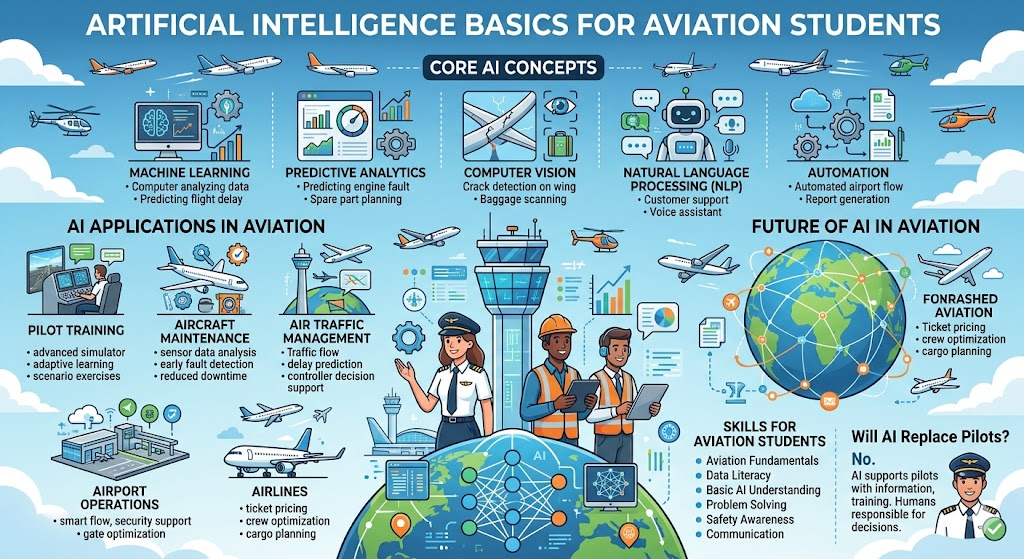
Core AI Concepts Every Aviation Student Should Know
1- Machine Learning
Machine Learning allows computers to learn from historical data and improve predictions over time. In aviation, this can be used for maintenance planning, demand forecasting, fuel optimization, safety analysis, and flight delay prediction.
For example, if an airline has years of data about aircraft parts, weather conditions, and maintenance reports, a machine learning model can identify patterns that humans may miss.
2- Predictive Analytics
Predictive analytics uses data to forecast what may happen next. In aviation, it can help predict aircraft component failure, passenger demand, weather disruption, airport congestion, and schedule delays.
Predictive maintenance is one of the most common examples. Instead of waiting for a part to fail, AI can help detect early warning signs and recommend inspection or replacement.
3- Computer Vision
Computer Vision allows computers to understand images and videos. In aviation, it can support aircraft inspection, runway monitoring, airport security, baggage scanning, and passenger identity verification.
For example, computer vision systems may help detect cracks, dents, corrosion, or surface damage on aircraft parts using images.
4- Natural Language Processing
Natural Language Processing, or NLP, helps computers understand and generate human language. In aviation, NLP can be used in chatbots, voice-based systems, customer support, training tools, and document analysis.
For example, an airline chatbot can answer passenger questions about baggage rules, flight status, check-in, and booking changes.
5- Automation
Automation means using technology to perform repeated tasks with minimal human effort. AI-powered automation is more flexible because it can learn from data and adapt to changing situations.
In aviation, automation may support airport operations, airline scheduling, report generation, safety monitoring, and customer service.
AI Applications in Aviation
AI in Pilot Training
AI can support pilot training through advanced simulators, adaptive learning platforms, performance tracking, and scenario-based exercises. A training system can analyze a student pilot’s performance and identify areas where improvement is needed.
For example, if a student struggles with approach planning or emergency response, an AI-based training tool can recommend targeted practice scenarios.
AI does not replace flight instructors. Instead, it supports instructors with better data and personalized training insights.
AI in Aircraft Maintenance
Aircraft maintenance is one of the strongest areas for AI adoption. Modern aircraft generate large volumes of sensor and performance data. AI can analyze this data to detect unusual patterns and predict possible faults.
Benefits of AI in maintenance include:
- Early fault detection
- Reduced aircraft downtime
- Better spare parts planning
- Improved maintenance scheduling
- Lower operational disruption
- Higher aircraft availability
Predictive maintenance helps airlines fix issues before they become serious operational or safety problems.
AI in Air Traffic Management
Air traffic management requires accurate decision-making, coordination, and timing. AI can help analyze air traffic flow, weather data, route conflicts, and airport congestion.
AI may support:
- Route optimization
- Delay prediction
- Conflict detection
- Airspace capacity planning
- Traffic flow management
- Controller decision support
AI in air traffic control must be carefully tested and regulated because safety is the highest priority.
AI in Airport Operations
Airports are complex environments with passengers, aircraft, baggage, security, ground vehicles, shops, staff, and real-time schedules. AI can help airports manage these activities more efficiently.
Common airport AI applications include:
- Smart passenger flow management
- Baggage tracking
- Security screening support
- Facial recognition systems
- Queue prediction
- Resource planning
- Runway and gate optimization
Smart airports use data and automation to reduce delays and improve passenger experience.
AI in Airlines
Airlines use AI for both operational and customer-facing activities. AI can help with crew scheduling, revenue management, customer service, route planning, fuel optimization, cargo operations, and disruption management.
Examples include:
- Flight delay prediction
- Dynamic ticket pricing
- Passenger demand forecasting
- Crew roster optimization
- Customer support chatbots
- Personalized travel recommendations
- Cargo planning and tracking
AI helps airlines make better use of aircraft, crew, fuel, and time.
AI in Aviation Safety
Safety is the foundation of aviation. AI can support safety by analyzing incident reports, maintenance data, weather data, pilot training data, and operational trends.
AI can help identify risk patterns before they become major problems. For example, if many minor issues appear repeatedly across different aircraft or routes, AI can help safety teams investigate them earlier.
However, AI safety systems must be transparent, reliable, explainable, and supervised by trained aviation professionals.
Benefits of AI for Aviation Students
For aviation students, learning AI basics offers several benefits:
- Better understanding of modern aviation technology
- Improved career readiness
- Stronger decision-making skills
- Ability to work with digital aviation systems
- Awareness of future aviation trends
- Better communication with technical teams
- More career options in aviation technology
Students who understand AI can become more valuable in roles related to airline operations, airport management, maintenance planning, aviation safety, flight training, and aviation analytics.
Challenges and Limitations of AI in Aviation
AI has many benefits, but aviation students must also understand its limitations.
Data Quality
AI depends on data. If the data is incomplete, outdated, biased, or incorrect, the AI system may produce poor results.
Safety and Certification
Aviation systems must meet strict safety standards. AI tools used in safety-critical environments must be tested carefully before deployment.
Cybersecurity
AI systems use data and digital infrastructure, which makes cybersecurity very important. Aviation organizations must protect AI systems from misuse, hacking, and data breaches.
Human Oversight
AI should support humans, not remove responsibility from them. Pilots, engineers, controllers, and managers must remain in control of critical decisions.
Explainability
Some AI systems are difficult to explain. In aviation, professionals must understand why a system makes a recommendation, especially in safety-related situations.
Skills Aviation Students Should Develop
Aviation students do not need to become AI experts immediately, but they should build strong foundational skills.
Important skills include:
- Basic understanding of AI and machine learning
- Data literacy
- Aviation safety awareness
- Critical thinking
- Problem-solving
- Digital tool usage
- Basic statistics
- Understanding dashboards and analytics
- Communication with technical teams
- Ethical and responsible technology awareness
Students who combine aviation knowledge with data and AI awareness will have a strong advantage.
Career Opportunities Combining AI and Aviation
AI is creating new career paths in aviation. Some possible roles include:
Aviation Data Analyst
Analyzes aviation data to improve operations, safety, maintenance, and performance.
AI Aviation Specialist
Works on AI-based aviation tools, systems, and implementation projects.
Predictive Maintenance Analyst
Uses aircraft data to predict maintenance needs and reduce downtime.
Airline Operations Analyst
Uses data and AI insights to improve flight schedules, crew planning, and operational efficiency.
Airport Technology Specialist
Supports smart airport systems, passenger flow tools, security technology, and automation.
Aviation Safety Analyst
Uses data to identify safety risks, trends, and improvement opportunities.
Air Traffic Systems Analyst
Works with digital systems that support traffic flow, route planning, and airspace management.
Will AI Replace Pilots?
AI will not replace pilots in the near future. Aviation is a safety-critical industry where human judgment, experience, communication, and responsibility remain essential.
AI can support pilots by providing better information, alerts, recommendations, and training insights. However, pilots are still responsible for decision-making, especially in complex, uncertain, or emergency situations.
The future is more likely to involve AI-assisted pilots rather than pilotless commercial aviation becoming common immediately.
Future of AI in Aviation
The future of AI in aviation may include:
- More intelligent pilot assistance systems
- Advanced flight simulators
- Smarter aircraft maintenance
- More efficient air traffic management
- AI-powered airport operations
- Better weather and disruption prediction
- Sustainable route and fuel optimization
- More personalized passenger services
- Advanced autonomous system research
The future aviation professional will need to understand both flying principles and digital systems.
Quick Learning Roadmap for Aviation Students
Step 1- Learn AI Basics
Start with basic concepts such as AI, machine learning, data, algorithms, and prediction.
Step 2- Understand Aviation Data
Learn what types of data are used in aviation, such as weather data, aircraft sensor data, passenger data, maintenance logs, and flight schedules.
Step 3- Study Real Aviation Use Cases
Focus on practical areas like predictive maintenance, pilot training, airport operations, and airline scheduling.
Step 4- Build Digital Skills
Learn basic spreadsheet analysis, dashboards, data visualization, and simple analytics tools.
Step 5- Stay Updated
Follow aviation technology trends, safety updates, smart airport developments, and AI regulations.
Frequently Asked Questions
1- What is Artificial Intelligence in aviation?
Artificial Intelligence in aviation means using intelligent computer systems to support aviation tasks such as maintenance, flight planning, pilot training, airport operations, safety monitoring, customer service, and air traffic management. It helps aviation professionals analyze data, identify patterns, and make better decisions.
2- Why should aviation students learn AI?
Aviation students should learn AI because modern aviation is becoming more digital and data-driven. Understanding AI helps students prepare for future roles in airlines, airports, maintenance, safety, training, and aviation technology.
3- Is AI difficult for aviation students to learn?
AI basics are not difficult if explained in simple language with aviation examples. Students can begin with concepts like data, prediction, automation, machine learning, and real-world aviation use cases before moving into technical details.
4- How is AI used in aircraft maintenance?
AI is used in aircraft maintenance to analyze sensor data, detect unusual patterns, predict component failures, schedule inspections, and reduce aircraft downtime. This is commonly known as predictive maintenance.
5- Can AI replace pilots?
AI is not expected to replace pilots in regular commercial aviation soon. Instead, AI will support pilots with better information, alerts, training tools, and decision-assistance systems while humans remain responsible for critical decisions.
6- How does AI improve flight safety?
AI can improve flight safety by detecting risks early, analyzing operational data, identifying maintenance issues, supporting pilot training, and helping safety teams find hidden patterns in reports and incidents.
7- What is machine learning in aviation?
Machine learning in aviation means using data to train computer models that can make predictions or identify patterns. It can be used for delay prediction, fuel optimization, maintenance planning, and passenger demand forecasting.
8- What are examples of AI in airports?
Examples include smart security screening, facial recognition, baggage tracking, passenger flow prediction, queue management, airport resource planning, and runway monitoring systems.
9- What skills should aviation students learn for AI careers?
Students should learn aviation fundamentals, data literacy, basic AI concepts, analytics tools, problem-solving, safety awareness, and communication skills. Programming knowledge can also help, but it is not always required for beginner-level understanding.
10- What is the future of AI in aviation?
The future of AI in aviation includes smarter aircraft systems, advanced pilot training, predictive maintenance, intelligent airports, better air traffic management, improved safety systems, and more efficient airline operations.
Conclusion
Artificial Intelligence is becoming a powerful part of the aviation industry. For aviation students, learning AI basics is no longer optional; it is an important step toward understanding the future of flying, airports, airlines, maintenance, and aviation safety. AI can help aviation professionals make faster decisions, improve efficiency, reduce delays, enhance passenger experience, and support safer operations. However, AI must always be used responsibly, with strong human oversight, reliable data, cybersecurity, and aviation safety standards. Students who begin learning AI today will be better prepared for tomorrow’s aviation careers. The best approach is to start with the basics, connect every concept with real aviation examples, and keep building knowledge as the industry evolves.