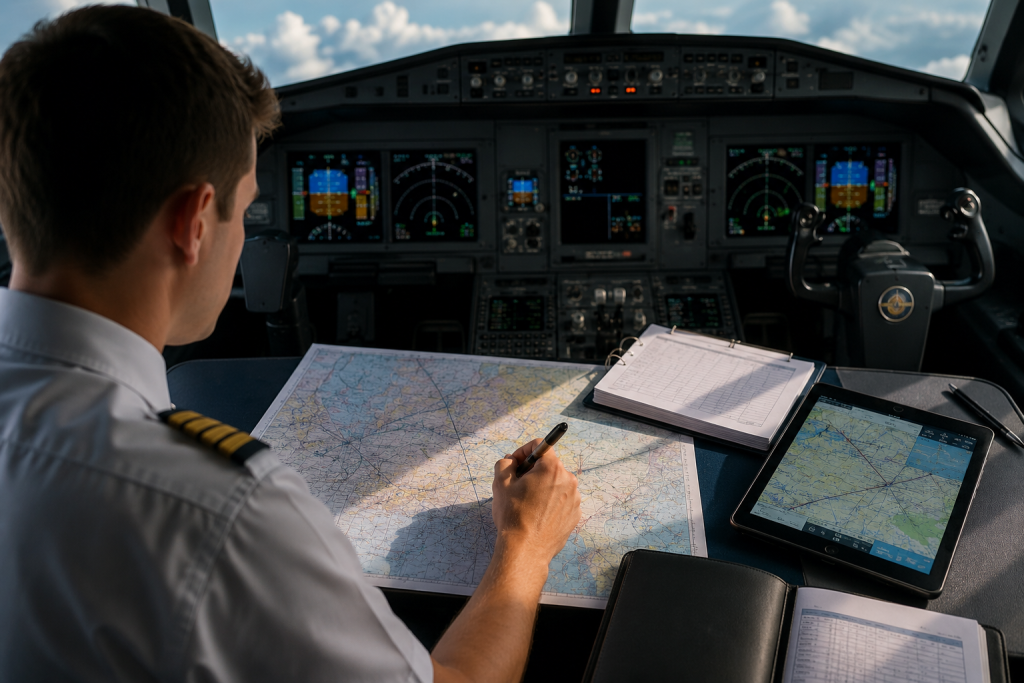
When student pilots begin flight training, most of the focus naturally goes toward aircraft control, procedures, navigation, weather, and regulations. These are the foundations of becoming a safe and competent pilot.
But there is one skill that often gets less attention early on — understanding how flight time is actually calculated.
At first, it may seem simple. Measure the distance, divide by speed, and you have your answer.
In real aviation, it is rarely that straightforward.
For pilots, especially those planning to move into commercial aviation, business aviation, or airline operations, understanding flight time calculations builds stronger decision-making, better situational awareness, and a deeper understanding of how professional flight operations work.
Flight Time Is More Than Distance
A common mistake among new pilots is assuming that flight time equals direct distance divided by cruise speed.
That may work in theory, but real-world flying introduces many variables.
Actual flight time depends on:
- Wind direction and speed
- Airway routing
- Airspace restrictions
- Climb and descent performance
- Holding patterns
- Alternate routing
- Traffic delays
- Weather deviations
This is why a 500-nautical-mile route can sometimes take longer than expected, even in good conditions.
Professional pilots learn very quickly that planning based only on straight-line distance can create unrealistic expectations.
Winds Change Everything
One of the biggest variables in aviation is wind.
A strong tailwind can significantly reduce flight time and fuel burn, while a headwind can add both time and operational cost.
This is one reason why airline and business aviation dispatch teams constantly update flight planning based on upper wind forecasts.
According to the Wikipedia article on flight planning, wind correction remains one of the most important elements of accurate route planning.
Understanding this early helps student pilots develop better fuel awareness and stronger planning habits.
Airway Routing vs Direct Routing
Many student pilots train using simplified direct navigation.
But in real-world IFR operations, aircraft rarely fly direct from departure to destination.
Instead, they follow structured airways, SIDs, STARs, and ATC restrictions.
Organizations like EUROCONTROL help manage and coordinate these complex routing systems across Europe.
For pilots planning to move into international operations, understanding airway structure becomes essential.
This is where theoretical planning starts to become operational planning.
Fuel Planning Starts With Time Planning
Flight time directly affects fuel.
And fuel affects everything.
Reserve fuel, alternate fuel, contingency fuel, holding fuel — all depend on realistic flight time calculations.
The FAA Pilot’s Handbook of Aeronautical Knowledge emphasizes that accurate fuel planning is one of the most critical responsibilities of any pilot.
Poor time estimation can quickly lead to poor fuel decisions.
This is why professional pilots and dispatchers spend so much time refining calculations before departure.
Learning to Think Like a Professional Pilot
Student pilots often focus on passing checkrides.
Professional pilots focus on managing the entire operation.
That includes:
- route efficiency
- fuel management
- weather impact
- alternate airports
- delays
- aircraft performance limitations
This broader mindset separates experienced pilots from beginners.
One of the best ways to build this operational mindset early is by practicing with real-world flight time calculator tools that simulate how routes are planned in business and commercial aviation.
Better Planning Builds Better Decision-Making
Good pilots don’t just fly aircraft.
They manage time, fuel, risk, and expectations.
The ability to understand why a flight takes as long as it does makes you more adaptable, more efficient, and better prepared for complex operational environments.
As aviation becomes more data-driven and technologically advanced, pilots who understand operational planning will have a stronger advantage in the industry.
Because in aviation, better decisions often begin long before takeoff — and it usually starts with understanding the clock.