Introduction
Aviation education is entering a new phase where technology is becoming an important part of how students learn, practice, and prepare for future careers. Traditional aviation education has always depended on classroom learning, expert instructors, flight simulators, real-world practice, safety procedures, aircraft systems knowledge, and disciplined training. These foundations will continue to remain important because aviation is a safety-first industry.
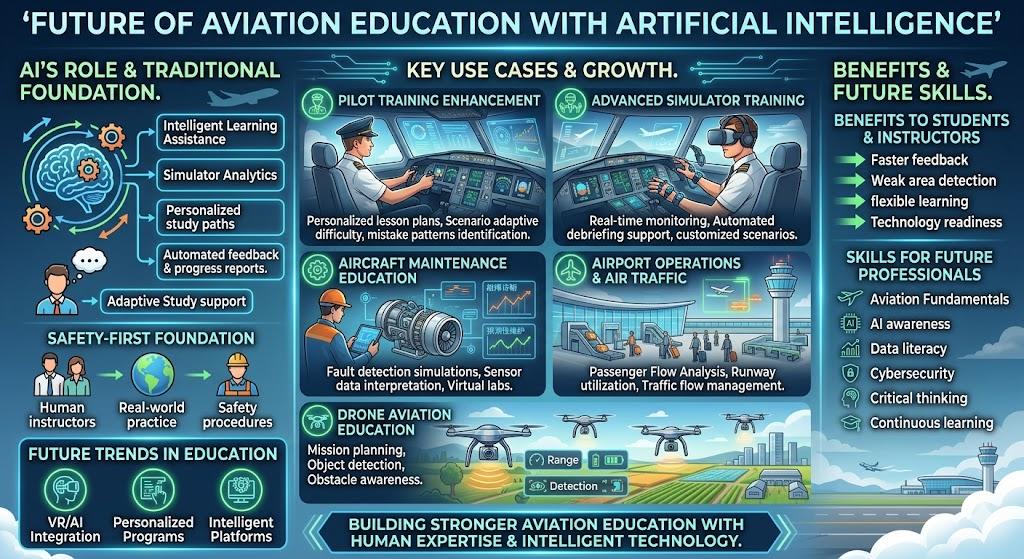
Artificial Intelligence is now becoming a powerful support tool in aviation education. It can help students learn at their own pace, support instructors with better performance data, improve simulator training, provide faster feedback, and prepare learners for modern aviation careers. AI can also help aviation academies create smarter training systems that are more personalized, practical, and data-driven.
However, AI does not replace instructors, real flight training, aircraft maintenance practice, or safety discipline. Instead, it supports the learning process. The future of aviation education will be strongest when human expertise and intelligent technology work together.
This blog explains how Artificial Intelligence is shaping the future of aviation education and what students, instructors, and aviation academies should understand.
What Is Artificial Intelligence in Aviation Education?
Artificial Intelligence in aviation education means using smart digital systems to support learning, training, assessment, and performance improvement. These systems can analyze data, identify learning gaps, provide feedback, recommend lessons, and help students practice aviation concepts more effectively.
In simple words, AI works like a learning assistant. It can observe patterns in student performance and help instructors understand where a learner needs improvement. For example, if a student repeatedly struggles with weather interpretation, simulator checklist timing, or aircraft systems questions, an AI-supported platform can identify that pattern and suggest focused revision.
AI in aviation education may include:
- Intelligent learning systems
- Adaptive training platforms
- Simulator analytics
- Digital learning assistants
- Personalized study paths
- Automated feedback
- Performance tracking
- Smart quizzes
- Virtual practice tools
- Training progress dashboards
AI makes education more informed and personalized, but it still needs human guidance. In aviation, instructors, trainers, and safety experts remain essential.
Why Aviation Education Is Changing
Aviation education is changing because the aviation industry itself is changing. Aircraft are becoming more advanced, airports are becoming more digital, and aviation operations are becoming more data-driven. Students preparing for aviation careers must understand both traditional aviation knowledge and modern technology.
Growing Aviation Technology
Modern aviation uses advanced navigation systems, digital cockpits, automated alerts, maintenance diagnostics, airport management systems, drone platforms, and data-based decision tools. Aviation education must prepare students to work confidently with these technologies.
Increasing Data Usage
Aviation produces large amounts of data from aircraft, simulators, airports, maintenance systems, weather platforms, safety reports, and passenger services. AI can help students and professionals understand how data supports better decisions.
More Advanced Aircraft Systems
Aircraft systems are becoming more connected and complex. Students need to understand engines, avionics, sensors, automation, digital displays, and maintenance data.
Modern Airport Operations
Airports now use digital tools for passenger flow, baggage handling, gate planning, security support, and resource management. Airport operations students must learn how technology supports these functions.
Digital Cockpit Environments
Aspiring pilots must become familiar with digital cockpit displays, automation, alerts, flight management systems, and decision-support tools. AI awareness can help them understand how future cockpits may evolve.
Demand for Faster and Better Training
Aviation training can be challenging and time-consuming. AI can help students receive quicker feedback, identify weaknesses earlier, and practice more effectively.
Remote and Hybrid Learning Opportunities
Digital learning platforms allow students to revise concepts, take quizzes, attend virtual sessions, and practice with online tools. AI can make remote and hybrid learning more personalized.
Future Workforce Requirements
Future aviation professionals may need skills in aviation, data awareness, AI basics, cybersecurity, communication, and digital tools. Education must prepare students for this shift.
Traditional Aviation Education vs AI-Supported Aviation Education
AI-supported aviation education does not remove traditional training. It improves how training is planned, delivered, measured, and personalized.
| Area | Traditional Aviation Education | AI-Supported Aviation Education |
|---|---|---|
| Classroom Learning | Instructor-led lessons and fixed study material | Personalized lessons and adaptive study support |
| Simulator Training | Instructor observes and gives feedback | Simulator data is analyzed for deeper feedback |
| Student Assessment | Standard tests and manual review | Smart quizzes and weak-area detection |
| Progress Tracking | Manual records and general performance notes | Data-based dashboards and progress reports |
| Instructor Feedback | Based mainly on observation and experience | Supported by AI-generated learning insights |
| Learning Personalization | Same path for many students | Customized learning based on performance |
| Training Efficiency | Depends on fixed schedules and manual review | Faster feedback and targeted practice |
| Skill Development | Built through lessons, practice, and instructor guidance | Enhanced with scenario-based AI practice |
The future of aviation education will combine both methods. Traditional aviation training gives students discipline, human judgment, and practical experience. AI adds personalization, analytics, and smarter feedback.
How AI Is Transforming Pilot Training
Pilot training is one of the most important areas where AI can support learning. Becoming a pilot requires strong knowledge of flight theory, aircraft systems, navigation, weather, communication, regulations, emergency procedures, and cockpit discipline.
AI can support pilot training in many ways.
Personalized Learning Plans
Not every student learns at the same speed. Some students may be strong in theory but weak in simulator decision-making. Others may understand procedures but struggle with weather or navigation. AI can help create personalized learning plans based on student performance.
Simulator Performance Analysis
AI can analyze simulator sessions and identify repeated mistakes. For example, it may highlight issues such as unstable approach practice, missed checklist steps, poor altitude control, or delayed emergency response.
Adaptive Learning Modules
AI-supported learning modules can adjust difficulty based on student progress. A beginner can start with basic concepts, while an advanced learner can move toward more complex scenarios.
Emergency Scenario Practice
AI can help create realistic emergency training scenarios in simulators. Students can practice engine issues, communication problems, navigation challenges, weather changes, and decision-making under pressure.
Weather Decision-Making Exercises
Weather is a major part of aviation safety. AI can help students practice weather interpretation through changing conditions, route decisions, and risk-based scenarios.
Flight Procedure Training
AI can support repeated practice of cockpit procedures, checklist discipline, radio communication, and standard operating procedures.
Progress Monitoring
Students and instructors can track progress over time. Instead of only seeing test scores, they can understand patterns, improvements, and weak areas.
Training Reports for Instructors
AI can help instructors by summarizing student performance and suggesting areas that need more attention. This saves time and makes training more focused.
AI supports pilot training, but it does not replace certified instructors or real flight experience. Human judgment and practical flying remain essential.
Future of Flight Simulator Training
Flight simulators are already a key part of aviation training. In the future, AI can make simulator training more intelligent, adaptive, and realistic.
Real-Time Performance Monitoring
AI can monitor student actions during simulator sessions, including altitude control, heading accuracy, checklist timing, decision-making, and communication.
Adaptive Difficulty Levels
The simulator can adjust difficulty based on the student’s skill level. If a student performs well, the system can introduce more complex scenarios. If the student struggles, it can provide simpler practice before moving forward.
Customized Scenarios
AI can create training scenarios based on a student’s weak areas. For example, if a student struggles with crosswind landing, the simulator can provide more crosswind practice.
Automated Debriefing Support
After a session, AI can generate a summary of key moments, mistakes, and improvement areas. This helps instructors conduct better debriefings.
Decision-Making Analysis
AI can help review why a student made certain decisions during a scenario. This is useful for teaching judgment, safety awareness, and threat management.
Emergency Response Training
Students can practice emergency procedures repeatedly in a safe environment. AI can adjust the situation based on the student’s response.
Weak-Area Identification
AI can detect repeated problems across multiple sessions. This helps students focus on the skills that need improvement most.
Continuous Improvement Tracking
AI-supported simulators can track performance over time, showing whether a student is improving in specific areas.
AI-Powered Personalized Learning
Personalized learning is one of the biggest advantages of AI in aviation education. In traditional education, many students follow the same lesson plan. While structure is important, students often have different strengths, weaknesses, and learning speeds.
AI can help personalize learning based on:
- Learning speed
- Knowledge gaps
- Assessment results
- Simulator performance
- Career goals
- Training progress
- Study habits
- Practical performance
- Quiz results
- Instructor feedback
For example, a student who wants to become a pilot may need extra practice in navigation and weather. A student interested in maintenance may need more aircraft systems learning. A student interested in airport operations may need passenger flow and resource planning exercises.
Personalized learning can improve student success because it reduces guesswork. Students know what to study next, and instructors know where to focus their support.
AI and Aviation Safety Education
Safety is the foundation of aviation education. AI can support safety learning by helping students understand risks, analyze scenarios, and practice better decisions.
AI can support aviation safety education through:
Risk Awareness Training
AI can help students study risky situations and understand how small errors can lead to bigger problems.
Incident Case Study Analysis
Students can use AI-supported tools to review aviation incidents, identify contributing factors, and understand lessons learned.
Human Factors Learning
Aviation safety is deeply connected to human behavior, decision-making, communication, fatigue, stress, and teamwork. AI can help create human factors scenarios for students.
Threat and Error Management
Students can practice identifying threats, managing errors, and making safer decisions in simulated situations.
Emergency Scenario Simulation
AI-supported simulations can help students practice emergency responses in a controlled environment.
Safety Reporting Education
Students can learn how safety reports are written, reviewed, and used to improve aviation systems.
Decision-Making Exercises
AI can create decision-based training where students must choose actions during changing aviation scenarios.
Safety education must remain supervised by qualified professionals. AI can support safety learning, but it cannot replace safety culture, discipline, and human responsibility.
AI in Aircraft Maintenance Education
Aircraft maintenance education is also changing because of AI. Modern aircraft generate data from sensors, engines, avionics, electrical systems, hydraulics, and maintenance records. Future maintenance learners need to understand how data supports technical decision-making.
AI can support maintenance education through:
Predictive Maintenance Learning
Students can learn how AI studies aircraft data to predict when a part may need inspection or replacement.
Fault Diagnosis Simulations
AI-supported simulations can help learners practice identifying technical faults and choosing troubleshooting steps.
Sensor Data Interpretation
Students can learn how changes in temperature, vibration, pressure, or system performance may indicate maintenance issues.
Digital Inspection Training
Virtual tools can help students practice inspection procedures and understand aircraft components.
Virtual Maintenance Labs
AI-supported virtual labs can allow learners to practice maintenance concepts before working on real equipment.
Aircraft Systems Analytics
Students can learn how aircraft systems behave and how data can reveal performance trends.
Troubleshooting Exercises
AI can generate technical scenarios where students must analyze symptoms and choose possible causes.
AI can make maintenance learning more practical, but hands-on training and certified supervision remain essential.
AI in Airport Operations and Air Traffic Education
Airport operations and air traffic education can also benefit from AI-supported learning. Airports are complex systems that require planning, coordination, communication, and safety awareness.
AI can help students learn:
Airport Management
Students can understand how airports manage terminals, gates, ground services, baggage, security, and passenger movement.
Passenger Flow Analysis
AI can help students study how passengers move through check-in, security, boarding, and baggage areas.
Resource Planning
Students can learn how staff, gates, vehicles, equipment, and ground teams are allocated.
Delay Prediction
AI can help students understand how weather, congestion, aircraft availability, and scheduling affect delays.
Traffic Flow Management
Students can study how aircraft movement is managed at busy airports and in controlled airspace.
Runway Utilization
AI-supported simulations can help students understand runway planning and airport capacity.
Operational Decision-Making
Students can practice making decisions during disruptions, crowding, delays, or weather events.
Airport Safety Management
AI can support safety scenario training related to ground operations, emergency response, and passenger safety.
AI can support air traffic education, but air traffic control remains a highly skilled human responsibility.
AI in Drone and Unmanned Aviation Education
Drone and unmanned aviation education is growing because drones are used in inspection, mapping, logistics, agriculture, emergency response, security, and research. AI can support drone learning in many ways.
AI-supported drone education may include:
Mission Planning
Students can learn how to plan drone missions based on route, purpose, battery, weather, and safety factors.
Object Detection
AI can help drones identify objects, obstacles, structures, or ground features.
Obstacle Awareness
Students can learn how AI supports safer navigation around obstacles.
Route Optimization
AI can suggest efficient routes based on mission goals and environmental conditions.
Flight Analytics
Students can study drone flight data to improve future missions.
Remote Pilot Support
AI can help remote pilots with alerts, mission review, and operational awareness.
Safety Planning
Drone education must include airspace rules, risk checks, emergency procedures, and responsible operation.
Autonomous System Awareness
Students can learn how autonomous systems work and why human supervision is still important.
Drone AI education prepares students for one of the fastest-growing areas of aviation technology.
Benefits of AI in Aviation Education
AI can bring many benefits to aviation education when used responsibly.
Personalized Learning
Students can receive learning paths based on their strengths, weaknesses, and goals.
Faster Feedback
AI can provide quicker feedback after quizzes, simulator sessions, and practice activities.
Improved Simulator Training
AI can make simulator training more realistic, adaptive, and useful for debriefing.
Better Safety Awareness
Scenario-based AI learning can help students understand risks and decision-making more clearly.
Data-Driven Progress Tracking
Students and instructors can track performance over time using dashboards and reports.
Instructor Support
AI can help instructors identify student needs and prepare more focused lessons.
Flexible Learning Opportunities
AI-supported platforms can support remote learning, self-study, and hybrid training.
Career Readiness
Students become more comfortable with digital systems, data, automation, and future aviation tools.
Technology Awareness
AI helps students understand how modern aviation systems are evolving.
Improved Student Engagement
Interactive tools, simulations, quizzes, and personalized feedback can make learning more engaging.
Challenges and Limitations
AI has many benefits, but aviation education must use it carefully.
AI Cannot Replace Human Instructors
Instructors provide judgment, motivation, correction, safety supervision, and real-world experience.
Technology Dependence Risks
Students should not depend only on AI tools. They must build real knowledge and practical skills.
Data Privacy Concerns
Training records, student performance data, and simulator results must be protected.
Cybersecurity Challenges
Digital aviation education platforms must be secured against cyber risks.
Training Costs
AI systems, simulators, software, and instructor training can require investment.
Need for Validation and Oversight
AI feedback must be checked for accuracy, especially in safety-related training.
Regulatory Considerations
Aviation training must align with safety rules and regulatory requirements.
Need for Real-World Practice
AI and simulators cannot replace real aircraft exposure, maintenance practice, or supervised aviation experience.
Importance of Human Judgment
Aviation requires decision-making, communication, responsibility, and situational awareness.
Skills Future Aviation Students Should Learn
Students preparing for the future should build both aviation and digital skills.
Important skills include:
- Aviation fundamentals
- Aircraft systems
- Flight theory
- AI awareness
- Data literacy
- Digital technology skills
- Cybersecurity awareness
- Communication skills
- Critical thinking
- Problem-solving
- Safety mindset
- Adaptability
- Continuous learning
- Documentation skills
- Teamwork
Students do not need to become AI experts immediately. They should first understand aviation fundamentals, then slowly build technology awareness.
Future Aviation Careers Influenced by AI
AI will influence many aviation career paths. Students who understand AI and aviation together can explore different opportunities.
Pilot with AI Technology Awareness
Pilots will benefit from understanding automation, digital cockpits, AI-supported planning tools, and simulator analytics.
Aviation Data Analyst
Aviation data analysts study flight data, airport data, passenger data, safety records, or maintenance information.
AI Aviation Analyst
AI aviation analysts help organizations understand how AI can support aviation operations, training, maintenance, or safety.
Aircraft Maintenance Technology Specialist
This role focuses on digital maintenance systems, predictive maintenance, sensor data, and aircraft reliability.
Airport Operations Technology Specialist
This role supports airport operations using digital tools, passenger flow systems, and resource planning platforms.
Drone Operations Specialist
Drone professionals may work with mission planning, flight analytics, object detection, mapping, and safety monitoring.
Aviation Safety Data Analyst
Safety data analysts study safety reports, incidents, risks, and operational patterns.
Flight Operations Analyst
Flight operations analysts support route planning, fuel planning, weather impact analysis, and schedule performance.
Aviation Training Technology Specialist
This role supports digital aviation learning platforms, simulators, training analytics, and course design.
Aviation Software Support Professional
This career involves supporting aviation software used by airlines, airports, academies, or maintenance teams.
How Aviation Academies Can Prepare for the Future
Aviation academies should prepare for the future by adopting technology responsibly.
Integrate AI Responsibly
Academies should use AI as a support tool, not as a replacement for qualified instructors.
Support Instructors with Technology
AI should help instructors understand student performance, prepare lessons, and conduct better debriefings.
Maintain Safety-First Training
Technology should always support aviation safety, not weaken it.
Use Data-Driven Learning Tools
Academies can use dashboards and analytics to track student progress more effectively.
Provide Simulator Analytics
Simulator data can help instructors identify weak areas and improve training quality.
Protect Student Data
Student records, simulator performance, and training reports should be handled securely.
Balance Technology and Practical Experience
AI-supported learning should be combined with classroom instruction, simulator practice, real-world training, and human guidance.
Promote Continuous Learning
Aviation academies should help students stay updated with modern aviation technology and future industry needs.
What Students Should Do Today to Prepare for the Future
Students can begin preparing for AI-powered aviation education with simple steps.
Learn Aviation Fundamentals First
Understand aircraft, airports, flight operations, maintenance, weather, safety, and aviation terminology.
Understand AI Basics
Learn what AI is, how data is used, and how prediction, automation, and digital assistants work.
Practice with Simulators
Use simulators to connect theory with practical decision-making and procedure practice.
Build Small Aviation Technology Projects
Create simple projects such as a flight delay study, aviation FAQ chatbot, maintenance checklist tracker, or airport passenger flow dashboard.
Develop Communication Skills
Clear communication is essential in aviation, especially for pilots, instructors, airport teams, and maintenance professionals.
Study Safety Principles
Understand checklists, human factors, risk management, emergency procedures, and safety reporting.
Learn Aviation Terminology
Aviation has its own language. Learning terms daily can improve confidence and understanding.
Stay Updated on Technology Trends
Follow aviation technology developments, digital learning tools, AI use cases, and drone innovations.
Create a Learning Portfolio
Save your notes, projects, simulator summaries, case studies, and certificates.
Stay Curious and Adaptable
Aviation technology will keep changing. Students should be ready to keep learning.
Future Trends in Aviation Education
The future of aviation education will include more intelligent, flexible, and data-driven learning systems.
AI-Powered Virtual Instructors
Virtual learning assistants may help students revise concepts, answer basic questions, and practice quizzes.
Smarter Simulators
Simulators may become more adaptive, realistic, and personalized based on student performance.
Personalized Training Programs
Students may receive training paths based on goals, skills, progress, and weak areas.
Remote and Hybrid Aviation Learning
Students may combine classroom learning, online lessons, simulator sessions, and self-paced digital practice.
Virtual Reality and AI Integration
Virtual reality and AI may create more immersive training environments for aircraft systems, cockpit practice, and maintenance learning.
Advanced Maintenance Simulations
Maintenance students may practice troubleshooting and inspection in digital environments before hands-on training.
Digital Assessment Systems
Assessments may become more personalized and data-driven, helping students understand exactly where they need improvement.
Intelligent Aviation Learning Platforms
Aviation academies may use platforms that combine lessons, quizzes, simulations, analytics, and instructor feedback.
Data-Driven Training Management
Academies may use data to improve course quality, student support, and training outcomes.
Technology-Enabled Career Development
Students may use digital portfolios, skill dashboards, and project-based learning to prepare for aviation careers.
Common Misconceptions About AI in Aviation Education
Students should understand what AI can and cannot do.
AI Will Replace Instructors
This is not true. AI can support instructors, but it cannot replace human guidance, experience, safety supervision, and motivation.
AI Will Replace Pilots
AI may support pilots, but aviation still requires trained professionals, human judgment, and regulatory responsibility.
Students No Longer Need Fundamentals
This is false. AI is useful only when students understand aviation basics first.
Technology Can Replace Practical Experience
AI and simulators help with practice, but real-world aviation experience remains essential.
AI Always Provides Correct Answers
AI can make mistakes. Students must verify important information with instructors and approved learning material.
Simulation Alone Is Enough for Training
Simulators are valuable, but complete aviation training requires human instruction, practical experience, and safety discipline.
Practical Tips for Aviation Students
Students can prepare for the future of aviation education by following these practical tips.
Focus on fundamentals before advanced technology. Learn aircraft, airports, safety, weather, flight theory, and aviation terminology first.
Use AI as a learning support tool. It can help with revision, summaries, quizzes, and explanations, but it should not replace your own understanding.
Verify important information with instructors. This is especially important for safety-related topics.
Practice consistently. Aviation learning improves through regular study, simulator practice, and review.
Build projects. Small projects help you connect aviation and AI practically.
Stay safety-focused. Technology should always support safe decisions and responsible learning.
Develop communication skills. Aviation professionals must communicate clearly and accurately.
Learn digital tools gradually. Start with simple tools before moving to advanced platforms.
Keep notes and documentation. Good aviation learners organize their knowledge carefully.
Think critically. Do not accept every AI answer as correct. Ask questions, compare sources, and understand the reason behind the answer.
Frequently Asked Questions
1- What is AI in aviation education?
AI in aviation education means using intelligent digital systems to support aviation learning, training, assessment, and performance tracking. It can help students receive personalized lessons, simulator feedback, weak-area analysis, and progress reports. AI supports learning, but instructors and practical training remain essential.
2- How does AI help pilot training?
AI helps pilot training by supporting personalized learning, simulator performance analysis, emergency scenario practice, weather decision-making exercises, and progress monitoring. It can help instructors identify student weaknesses and provide more focused training support.
3- Can AI replace flight instructors?
No, AI cannot replace flight instructors. Instructors provide safety supervision, real-world experience, correction, motivation, and professional judgment. AI can support instructors with data and reports, but human guidance remains necessary.
4- How is AI used in simulators?
AI can be used in simulators to monitor performance, adjust difficulty, create customized scenarios, identify weak areas, support debriefing, and track improvement over time. This makes simulator training more practical and personalized.
5- What skills should future aviation students learn?
Future aviation students should learn aviation fundamentals, aircraft systems, flight theory, AI awareness, data literacy, digital tools, cybersecurity awareness, communication, critical thinking, problem-solving, safety mindset, adaptability, and continuous learning.
6- Can AI improve aviation safety education?
Yes, AI can improve aviation safety education by supporting risk awareness training, incident analysis, emergency scenario simulation, human factors learning, threat and error management, and decision-making exercises. Safety training still requires qualified human supervision.
7- Is AI useful for aircraft maintenance training?
Yes, AI is useful for aircraft maintenance training. It can help students learn predictive maintenance, fault diagnosis, sensor data interpretation, troubleshooting, virtual inspection, and aircraft systems analytics. Hands-on practice and expert supervision remain important.
8- What careers combine aviation and AI?
Careers that combine aviation and AI include aviation data analyst, AI aviation analyst, aircraft maintenance technology specialist, airport operations technology specialist, drone operations specialist, aviation safety data analyst, flight operations analyst, aviation training technology specialist, and aviation software support professional.
9- How can students prepare for AI-powered aviation careers?
Students can prepare by learning aviation fundamentals, understanding AI basics, practicing with simulators, building small aviation technology projects, improving communication skills, studying safety principles, learning aviation terminology, and creating a learning portfolio.
10- What is the future of aviation education?
The future of aviation education will likely be more personalized, interactive, data-driven, and technology-supported. AI will help with simulators, assessments, safety training, maintenance learning, and career preparation. However, human instructors, real-world practice, and safety discipline will remain essential.
Conclusion
Artificial Intelligence is shaping the future of aviation education by making learning more personalized, interactive, data-driven, and efficient. It can help students receive faster feedback, practice with smarter simulators, understand weak areas, improve safety awareness, and prepare for future aviation careers. At the same time, aviation education will always depend on human instructors, real-world experience, strong fundamentals, safety discipline, and responsible decision-making. AI should be used as a support tool, not as a shortcut or replacement for professional training. Students who want to succeed in future aviation careers should start with aviation basics, understand AI step by step, practice consistently, build small projects, and stay curious about new technology. With the right balance of human learning and intelligent tools, the future of aviation education can become more accessible, practical, and career-focused for beginners and professionals alike.