Introduction
Software is shipping faster than ever, but security incidents are also growing in frequency and impact. When security is treated as a separate last‑minute step, teams end up with fragile pipelines, production surprises, and compliance gaps. A Certified DevSecOps Architect is the person who solves this problem by building security into the heart of DevOps and cloud architecture from day one.
This guide explains the Certified DevSecOps Architect certification from DevSecOpsSchool, what you learn, who it is for, and how it fits into long‑term career paths such as DevOps, SRE, Security, AIOps/MLOps, DataOps, and FinOps. You will see skills covered, real‑world projects, preparation plans, role mappings, and FAQs so you can decide if this program is the right step for your growth.
What is a Certified DevSecOps Architect?
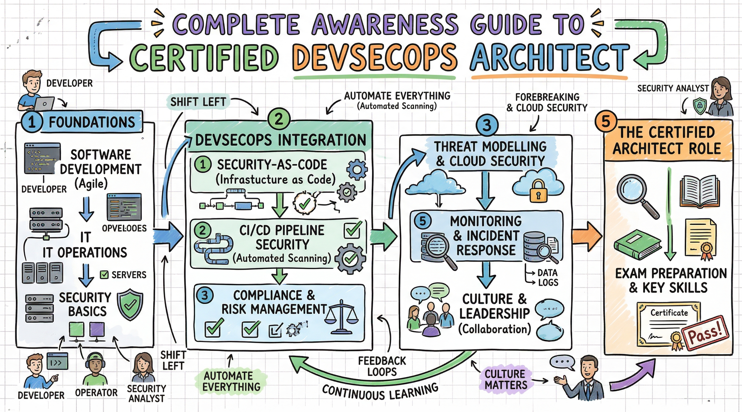
A Certified DevSecOps Architect is an engineer or leader who can design secure CI/CD pipelines, cloud platforms, and delivery processes where security is automated, continuous, and measurable. Instead of running tools in isolation, they connect threat modeling, SAST, DAST, SCA, secrets management, and compliance as code into a coherent architecture.
This role sits at the intersection of DevOps, security, and cloud architecture. You are expected to understand how code moves from idea to production, what can go wrong at each step, and how to embed security controls without blocking developer productivity.
Certified DevSecOps Architect in depth
What it is
Certified DevSecOps Architect is an advanced certification that proves you can design, review, and guide secure DevOps ecosystems across applications, pipelines, platforms, and cloud. It blends secure software design, automated security testing, compliance, and risk management with day‑to‑day engineering practices.
The focus is not just tool usage; it is about thinking like an architect who can balance speed, safety, and compliance for real organizations.
Who should take it
- DevOps engineers who already manage CI/CD and want to own security architecture end‑to‑end.
- Security engineers and AppSec specialists who want deeper influence on pipelines, cloud, and developer workflows.
- Cloud and platform engineers responsible for Kubernetes, microservices, and multi‑account/multi‑cluster environments.
- SREs who want to combine reliability with security and risk‑aware change management.
- Technical leads and engineering managers who must define secure DevOps standards and roadmaps.
Skills you’ll gain
- Understanding of DevSecOps principles and how they change traditional SDLC and DevOps models.
- Ability to map threats and controls across the entire pipeline: plan, code, build, test, deploy, and operate.
- Designing secure CI/CD pipelines with integrated SAST, DAST, SCA, container scanning, and secret scanning.
- Applying security as code: policies, guardrails, and compliance checks codified into pipelines and infrastructure.
- Building architectures for cloud and Kubernetes security (network policies, RBAC, least privilege, image security).
- Implementing governance, metrics, and dashboards that show security posture to engineering and leadership.
Real‑world projects you should handle after it
By the end of this certification, you should be able to:
- Design and implement a secure CI/CD pipeline that includes automated code scanning, dependency checks, container scanning, and policy gates.
- Create a DevSecOps reference architecture for a microservices application on Kubernetes, covering ingress, secrets, policies, and runtime security.
- Define a security controls map for a product or platform, linking threats to automated checks and manual reviews.
- Integrate compliance as code into pipelines (for example, checks for standards, tagging, encryption, and access control).
- Lead a security improvement initiative that reduces critical vulnerabilities in production over a defined period.
Preparation plan (7–14 / 30 / 60 days)
7–14 day fast‑track (for experienced DevOps/Security engineers)
- Day 1–2: Refresh DevOps pipeline stages and current security tools; review common attack surfaces in CI/CD.
- Day 3–4: Deep dive into SAST, DAST, SCA, container scanning, and secrets management patterns.
- Day 5–7: Design and document one secure end‑to‑end pipeline for a sample application; validate it with tools you already use.
- Day 8–10: Add governance: policies, compliance checks, and promotion rules across environments.
- Day 11–14: Practice scenario‑based questions and architecture reviews, focusing on trade‑offs and risk‑based decisions.
30‑day standard plan (for most working professionals)
- Week 1: DevSecOps fundamentals – secure SDLC, shift‑left concepts, pipeline risk mapping.
- Week 2: Tooling and integration – SAST, DAST, SCA, secret scanning, container and image security.
- Week 3: Cloud and Kubernetes security patterns, plus security as code and compliance as code.
- Week 4: Capstone project: design a DevSecOps architecture for a chosen stack, write a short design document, and review it like an architect.
60‑day foundation‑building plan (for those new to security or DevOps)
- First 2 weeks: DevOps basics – CI/CD, Git, build/test/deploy workflows, one major cloud provider.
- Next 2 weeks: AppSec basics – OWASP Top 10, vulnerability types, secure coding practices.
- Next 2 weeks: DevSecOps tooling – lab practice with SAST, DAST, SCA, and simple security checks in pipelines.
- Last 2 weeks: Architecture focus – design scenarios, threat modeling, and complete pipeline design for a sample project.
Common mistakes to avoid
- Treating DevSecOps as “just adding tools” instead of designing end‑to‑end secure flows.
- Forcing heavy manual security checks that slow teams, instead of automating checks where possible.
- Ignoring developer experience and breaking builds constantly without clear guidance or feedback.
- Focusing only on application code and ignoring infrastructure, cloud, and Kubernetes attack surfaces.
- Not defining metrics or KPIs, so leadership cannot see the value of DevSecOps improvements.
Best next certification after this
After Certified DevSecOps Architect, strong next moves are:
- Same‑track: a professional‑level DevSecOps or security certification that goes deeper into hands‑on security pipelines and operations.
- Cloud‑track: cloud architect certifications (AWS, Azure, GCP) to design secure cloud solutions end‑to‑end.
- Reliability/observability: an observability or SRE‑focused program, so you can connect security with reliability and incident response.
Choose your path: 6 learning paths with Certified DevSecOps Architect
1. DevOps path
For DevOps engineers, this certification turns “security as a blocker” into “security as part of the pipeline.”
A practical sequence:
- DevOps fundamentals and at least one cloud associate certification.
- Certified DevSecOps Architect to design secure pipelines and environments.
- Follow‑up: Kubernetes or platform engineering certifications to scale your architectures.
2. DevSecOps path
This is the most natural home for the certification.
A practical sequence:
- DevOps foundation + basic security course (Security+, or equivalent security fundamentals).
- Certified DevSecOps Architect as your core DevSecOps architecture credential.
- Follow‑up: specialized DevSecOps or security cloud certs (cloud security architect, zero‑trust, or container security).
3. SRE path
SRE teams need security integrated with reliability and change management.
A practical sequence:
- Cloud/SRE basics and an SRE‑oriented certification or training.
- Certified DevSecOps Architect to embed security gates and checks into release and incident processes.
- Follow‑up: observability or MOE‑style certifications to connect security signals with incident response.
4. AIOps / MLOps path
AIOps/MLOps pipelines also need secure data, models, and deployments.
A practical sequence:
- DevOps/SRE basics plus some ML or data engineering exposure.
- Certified DevSecOps Architect to secure pipelines, models, and cloud workloads.
- Follow‑up: AIOps/MLOps‑oriented certifications that use telemetry and security signals for automation.
5. DataOps path
Data platforms and pipelines carry sensitive information and need strong security controls.
A practical sequence:
- Data engineering or analytics‑focused certification on your main cloud.
- Certified DevSecOps Architect to secure data pipelines, ETL jobs, and analytics platforms.
- Follow‑up: advanced data or analytics certifications with a focus on governance and compliance.
6. FinOps path
FinOps needs secure and compliant usage of cloud resources, not just cost visibility.
A practical sequence:
- Cloud fundamentals and cost management basics.
- Certified DevSecOps Architect to enforce policies, guardrails, and compliance as code that also protect cost efficiency.
- Follow‑up: FinOps‑oriented learning or cloud governance certifications.
Role → Recommended certifications
| Role | Recommended certifications sequence |
|---|---|
| DevOps Engineer | DevOps foundation → cloud associate (AWS/Azure/GCP) → Certified DevSecOps Architect → Kubernetes or platform engineering certification |
| SRE | Cloud/SRE fundamentals → SRE‑oriented certification → Certified DevSecOps Architect → observability or SRE advanced program |
| Platform Engineer | Cloud architect or Kubernetes certification → Certified DevSecOps Architect → observability/reliability‑focused certification |
| Cloud Engineer | Cloud associate → cloud architect/professional → Certified DevSecOps Architect to secure multi‑account/multi‑region setups |
| Security Engineer | Security fundamentals/AppSec cert → Certified DevSecOps Architect → cloud security or red/blue‑team certifications |
| Data Engineer | Cloud data engineer → Certified DevSecOps Architect to secure data pipelines → advanced analytics or governance certifications |
| FinOps Practitioner | Cloud fundamentals → Certified DevSecOps Architect to enforce guardrails and policies → FinOps or governance‑oriented learning |
| Engineering Manager | DevOps/cloud overview → Certified DevSecOps Architect → leadership‑oriented SRE/DevOps strategy programs |
Next certifications after Certified DevSecOps Architect
Based on common certification roadmaps and recommendations for software engineers:
1) Same‑track (DevSecOps / security)
- A hands‑on DevSecOps Professional‑level certification focused on building and running secure pipelines in depth.
- Cloud security architect certification for your main cloud platform to secure large‑scale cloud systems.
2) Cross‑track (cloud / DevOps / SRE)
- Cloud architect (AWS/Azure/GCP) to complement your security design skills with strong cloud architecture expertise.
- SRE or observability‑oriented certifications to integrate security controls with reliability and monitoring practices.
3) Leadership‑track (architecture / strategy)
- Architecture‑oriented programs that focus on designing enterprise‑grade platforms, including security, reliability, and governance.
- DevOps/SRE leadership and transformation‑focused courses to drive organization‑wide DevSecOps adoption.
Top institutions for Certified DevSecOps Architect training
DevOpsSchool
DevOpsSchool is a key provider for DevOps and DevSecOps‑aligned certifications and offers structured programs for Certified DevSecOps Architect. Training usually includes instructor‑led sessions, labs, and real‑world project scenarios that map directly to exam and job requirements.
Cotocus
Cotocus delivers consulting‑driven DevOps and security training with a strong focus on real client use‑cases. For aspiring DevSecOps architects, it emphasizes reference architectures, secure cloud patterns, and implementation roadmaps.
ScmGalaxy
ScmGalaxy focuses on DevOps, SCM, and automation tooling. Its DevSecOps programs help engineers understand how to embed security into CI/CD, version control workflows, and multi‑tool pipelines.
BestDevOps
BestDevOps aggregates DevOps and security content, bootcamps, and courses. For Certified DevSecOps Architect candidates, it provides exposure to multiple tools and scenarios aligning with secure automation and cloud‑native practices.
devsecopsschool.com
DevSecOpsSchool is the primary home of the Certified DevSecOps Architect certification, focusing on security‑driven DevOps training. It emphasizes practical architectures, security as code, and patterns drawn from real organizations and projects.
sreschool.com
sreschool.com specializes in SRE and reliability concepts. Its learning paths complement DevSecOps Architect by helping you build secure and reliable platforms, especially around SLIs, SLOs, and incident response.
aiopsschool.com
aiopsschool.com targets AIOps and intelligent operations. It connects telemetry and automation with security signals, which is useful if you want to bring DevSecOps thinking into AIOps pipelines.
dataopsschool.com
dataopsschool.com focuses on DataOps and data platform reliability. Training here helps DevSecOps architects apply security controls and observability practices to data pipelines and analytics workloads.
finopsschool.com
finopsschool.com is centered on cloud cost and financial operations. It complements DevSecOps Architect by showing how security and governance affect cost efficiency and cloud usage.
FAQs (Certified DevSecOps Architect & general)
1. Is Certified DevSecOps Architect difficult?
Yes, it is an advanced‑level certification aimed at engineers and leaders who already understand DevOps and basic security. The difficulty mainly comes from architecture questions and trade‑off decisions, not just tool usage.
2. How long does it take to prepare?
With strong DevOps and security experience, 3–4 weeks of focused study and lab work is often enough. If you are newer to AppSec or CI/CD, plan for 6–8 weeks following a structured roadmap.
3. What are the minimum prerequisites?
You should know CI/CD workflows, Git, at least one cloud platform, and basic application security concepts like OWASP Top 10. Hands‑on exposure to Docker or Kubernetes is a strong plus.
4. In what sequence should I take this with other certifications?
A practical order is: DevOps foundation or cloud associate → security fundamentals → Certified DevSecOps Architect → deeper cloud security, SRE, or observability programs.
5. What real value does this certification add to my career?
It proves that you can design secure automation across pipelines and platforms, not just run scanners. This is highly valuable for senior DevOps, Security, and Cloud roles that need architecture‑level thinking.
6. Is this certification useful for freshers?
It is primarily aimed at working professionals. Freshers should first build DevOps and security basics, then consider this certification once they have some real project exposure.
7. Does the exam focus more on tools or architecture?
The emphasis is on architecture, risk‑based thinking, and integration patterns. Tools matter, but the exam expects you to see them as parts of a larger secure ecosystem.
8. What kind of roles can I target after this?
You can aim for DevSecOps Architect, Senior DevOps Engineer (Security‑focused), Cloud Security Architect, Platform Security Engineer, or Security‑aware SRE roles.
9. How does this differ from a generic security certification?
Generic security certifications often focus on network security, governance, or general cyber concepts. This one focuses specifically on DevOps pipelines, cloud, automation, and embedding security into daily engineering work.
10. Do I need coding skills for this?
You should be comfortable reading and writing configuration files, pipeline definitions, and simple scripts. Deep application development expertise is helpful but not mandatory; the focus is on integrating and architecting controls.
11. Is this certification recognized globally?
DevSecOps and security‑focused roles are growing across regions, and specialized DevSecOps certifications are increasingly mentioned in job descriptions for senior roles in India and worldwide.
12. How does it help for leadership roles?
It gives you a structured language and framework for discussing risk, security posture, and guardrails with teams and executives. This is crucial for leads, architects, and managers driving secure digital transformation.
13. Can this certification help me switch from security to DevOps, or vice versa?
Yes. It is a strong bridge certification for security engineers moving into DevOps‑heavy roles and DevOps engineers moving deeper into security architecture.
14. How do I know I am ready to attempt the exam?
You are ready if you can explain a CI/CD pipeline, point out security risks at each stage, and describe how to integrate tools like SAST, DAST, and SCA without breaking developer flow.
General FAQs about Certified DevSecOps Architect
1. Is Certified DevSecOps Architect only for large enterprises?
No. The concepts apply to startups, mid‑size companies, and large enterprises. Smaller teams often adopt DevSecOps earlier because they want to move fast without sacrificing security.
2. Can I pursue this certification while working full‑time?
Yes. Most professionals prepare alongside a full‑time job using a 30‑ or 60‑day plan with 1–2 focused hours per day and weekend deep‑dive sessions.
3. Do I need to be a “security expert” before starting?
You don’t need to be a pure security specialist, but you should understand basic vulnerabilities, authentication/authorization, and common risks in web or cloud apps. The program then builds on that.
4. Is this certification more technical or managerial?
It is primarily technical‑architect in nature. You’ll work with tools, pipelines, and architectures, but you also learn to communicate risks, trade‑offs, and designs to managers and stakeholders.
5. Will this help if my company is still doing manual releases?
Yes. The certification helps you design a roadmap to move from manual releases to secure, automated pipelines, which can be a strong internal transformation project.
6. Is this suitable if I mainly work on‑prem, not in cloud?
Yes. While many examples use cloud and containers, the patterns—secure pipelines, policy as code, automated testing—apply to on‑prem environments as well.
7. Can this certification help me negotiate a better role or salary?
It can. It shows you can own both DevOps and security concerns at an architectural level, which is valuable for senior engineer, architect, and lead roles.
8. How often should I update or refresh my DevSecOps knowledge?
DevSecOps is a fast‑moving space. Plan to refresh your knowledge every 1–2 years—through recertification, advanced courses, or hands‑on projects with new tools and cloud features.
Conclusion
Security can no longer live at the end of the release cycle. The Certified DevSecOps Architect program is designed to help you build secure automation as a foundation, not an afterthought. It brings together DevOps, cloud, and security into a single, architecture‑driven view of how modern systems should be built and run.
Whether you are a DevOps engineer, security specialist, SRE, cloud architect, data engineer, FinOps practitioner, or an engineering manager, this certification can significantly raise your impact and visibility. It signals that you understand both speed and safety—and that you know how to design pipelines and platforms where teams can move fast without breaking security.